Review: Confessions — the soul that talks to God
★★★★★5.0 / 5.0 (editorial rating)
Verdict: if you read only one book by Augustine, read this one. Youthful appetite and regret, the bond with his mother Monica, and at last the conversion in the garden — all told, astonishingly, as a prayer spoken directly to God. It is the West's first true autobiography and the fountainhead of the modern sense of an inward self. The early books, up to the conversion, are the most readable stretch of Augustine anywhere: this is where you get the "I can actually read this" feeling.
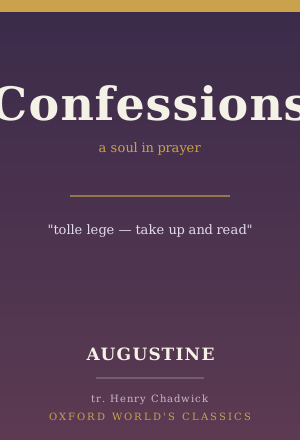
- Title
- Confessions (Oxford World's Classics)
- Author
- Augustine of Hippo
- Translator
- Henry Chadwick
- Publisher
- Oxford University Press (original: c. AD 397–400)
- Length
- Primary source · ~380 pp. (text + introduction and notes)
- Difficulty
- Intermediate ★★☆ — a primary text, but the narrative reads easily
Check price & availability on the Amazon product page
What it is — in three lines
A man from Roman North Africa looks back over his youthful desires and mistakes and asks why, and how, he turned toward God. But the person he addresses is not the reader — it is God: the whole book is a "you," a prayer. Boyhood theft, the study of rhetoric, a long-term partner, the pull of the Manichees, his mother Monica's tears, and the famous scene in a Milan garden where he hears a child chanting "tolle lege — take up and read." The early books, which carry the conversion, are the heart of it.
The core — self-scrutiny as prayer
What makes the Confessions epoch-making is how relentlessly it drives the question "who am I?" inward. Augustine does not merely confess his past deeds; he keeps asking why he wanted to do wrong in the first place. In the celebrated scene of the stolen pears, he was not hungry and did not even want the fruit — he stole simply because it was forbidden, and he analyses that gratuitous leaning toward evil at length. Here is a piercing psychology of motive, memory, and will. And it is at the same time a prayer: to look hard at oneself turns out to be a way of seeking God. That double movement is the core of the book, and the source of the whole later Western tradition of self-consciousness and the literature of the inner life. A line near the opening states the theme of the whole: our heart is restless until it rests in God.
You have made us for yourself, and our heart is restless until it rests in you.
— Augustine, Confessions I.1 (standard rendering)
Three highlights
1. The drama of the conversion
In the Milan garden, at the end of a long inner struggle, he hears a child's voice — "take up and read" — opens the letters of Paul, and turns. It is one of the great scenes in Western literature: not an argument that persuades, but the vivid moment when a will finally breaks and changes direction.
2. Monica
His mother, who prayed and wept over her wandering son for years, runs through the book like a ground bass. It is a book of faith and, at the same time, a universal story of a parent and a child — and it lands as such.
3. The psychology of the inner life
The writing on the tangles of desire, memory, and will reads like modern psychological self-analysis. For a book written sixteen centuries ago, it is uncannily alive to the reality of what goes on inside a person.
What to watch out for
Two honest notes. First, the later books change gear. After the narrative, Augustine turns to memory, to the nature of time, and to a close reading of the opening of Genesis — abstract, demanding stretches where many first-time readers stall. Our advice: read straight through the conversion, and take the final books lightly the first time, or skim and return. The story does not depend on mastering them. Second, on editions: there are several fine English Confessions (Chadwick for Oxford; R. S. Pine-Coffin and others for Penguin; Sarah Ruden's more recent version), and you need only one. We recommend the Chadwick because its introduction and notes are the most useful for a first serious reading; if you prefer a warmer, more colloquial English, Ruden's is worth a look. Either way, one translation is enough.
Check price & availability on the Amazon product page