Home › Top 5 › Very Short Introduction
Review: Augustine — A Very Short Introduction, the map before the originals
★★★★☆4.5 / 5.0 (editorial rating)
Verdict: the best thing to read before you open a primary text. In a hundred and forty-four pages, Henry Chadwick — the leading English authority on Augustine — draws the whole shape of the life and thought: the road from a clever boy in Roman North Africa to the man who set the terms of Latin Christian thought for a thousand years. Read it and every book of the Confessions suddenly has somewhere to sit.
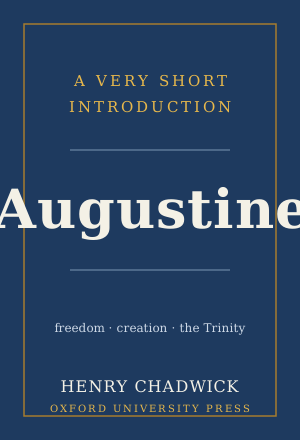
- Title
- Augustine: A Very Short Introduction
- Author
- Henry Chadwick
- Publisher
- Oxford University Press (Very Short Introductions)
- Length
- Introduction · 144 pp.
- Difficulty
- Beginner ★☆☆ — short, clear, and self-contained
Check price & availability on the Amazon product page
What it is — in three lines
One of Oxford's Very Short Introductions: a pocket-sized, single-author overview of Augustine's life and ideas. Its author, Henry Chadwick, was also the translator of the standard Oxford Confessions — so this is not a hack summary but a compression by a scholar who spent a career with the texts. In under 150 pages it covers the biography and the main lines of thought, and points you toward the works themselves.
The core — a whole life in outline
The value of a good introduction is that it hands you the map before the territory. Chadwick sets Augustine in his time — a Latin-speaking North Africa inside a Roman Empire beginning to fail — and traces the arc: the restless youth, the years with the Manichees, the conversion, the decades as bishop of Hippo, the great controversies of his old age. Along the way he lays out the ideas that the primary works turn on: freedom and the will, creation and time, evil, grace, and the Trinity. None of it is treated exhaustively; the point is to give you the coordinates, so that when you open the Confessions or the City of God you know roughly where you are and what is at stake. That is exactly what a first-time reader needs, and few books do it this efficiently.
Three highlights
1. Written by the right person
An introduction is only as trustworthy as its author, and Chadwick was among the foremost historians of the early Church. You are getting the distilled judgement of someone who knew the sources first-hand.
2. It makes the great works legible
Its real function is preparatory: read it first and the abstract passages of the Confessions, and the vast architecture of the City of God, stop being a fog. You will know which questions each book is trying to answer.
3. Genuinely short
An afternoon, not a term. For a figure as large as Augustine, having a reliable overview you can finish in one sitting is worth a great deal.
What to watch out for
Be clear about what this is: scaffolding, not the building. An introduction is no substitute for Augustine's own voice — read this and stop, and you will have opinions about the Confessions without having felt it. Use it for what it is: the map you carry into the primary texts, not a replacement for them. It is also, by design, compressed; on any single topic — grace, say, or the reading of Genesis — it can only gesture. That is the right trade for a first book, but do not mistake the gesture for the whole. The plan of this shelf is to read this first and then go straight to the Confessions.
Check price & availability on the Amazon product page