ARISTOTLE BOOK GUIDE
The 5 Best Aristotle Books (2026)
— from the Nicomachean Ethics to the Metaphysics, in reading order
Logic, biology, ethics, politics, the very idea of "being" — Aristotle is the closest thing philosophy has to a founder of everything, and most readers meet him by opening the Metaphysics cold, drowning in its technical vocabulary, and quietly closing the book. But there is a staircase up. The originals are hard, true; the usual cause of defeat is simply starting with the hardest one. Get the shape of the whole system from a short introduction, feel yourself actually reading an original in the Nicomachean Ethics, then climb through the Politics and a great modern study to the summit. Five books, ordered by readability, not fame — a map for not giving up.
The editorial room behind this site runs a family of philosopher bookshelves and a section-by-section reading archive of the primary texts (in Japanese). Every recommendation rests on first-hand reading, with the same rule throughout: never let you pick the wrong first book. See also our sister Socrates Bookshelf and the Japanese edition of this shelf.
Our RankingRANKING
The editorial order. If you can't decide, start at #1. Check prices and availability on the Amazon product pages.
-
1
 If in doubt, start hereIntermediate
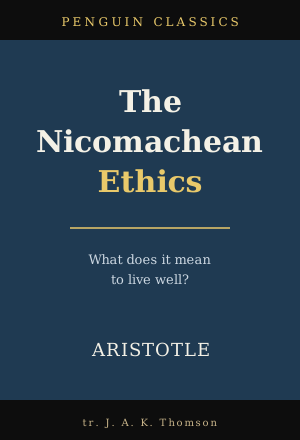
The Nicomachean Ethics (Penguin Classics)
The one Aristotle to read if you read only one. His great question — what is the highest human good? — answered as eudaimonia, flourishing, and grounded in virtues built by habit and aimed at a "mean" between excess and deficiency. Because it works through anger, money, and friendship, it is the most followable of the originals: the book where you first feel you can actually read Aristotle.
Check price & availability on Amazon
View on Amazon Read our review -
2
 Beginner
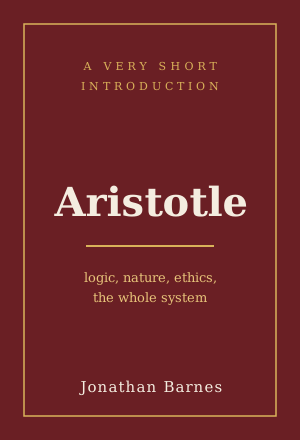
Aristotle: A Very Short Introduction
The gentlest possible entry, by one of the great Aristotle scholars. In under two hundred pages Barnes lays out the whole system — logic, the natural sciences, metaphysics, psychology, ethics, politics, art — and, crucially, shows how the pieces connect into a single picture of the world. Read this first and the originals stop being a maze; each becomes a room you can place on a map.
Check price & availability on Amazon / Kindle edition available
View on Amazon Read on Kindle Read our review -
3
 Intermediate
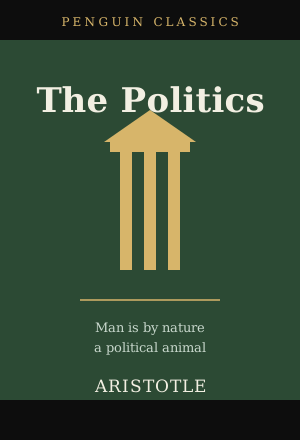
The Politics (Penguin Classics)
"Man is by nature a political animal." The companion to the Ethics: if the good life is the goal, the city is where it is lived. Aristotle compares real constitutions, dissects revolution, democracy, and oligarchy, and asks what a state is for. Concrete and argumentative rather than abstract, it is the natural second original after the Ethics — and startlingly current on citizenship and power.
Check price & availability on Amazon / Kindle edition available
View on Amazon Read on Kindle Read our review -
4
 Intermediate
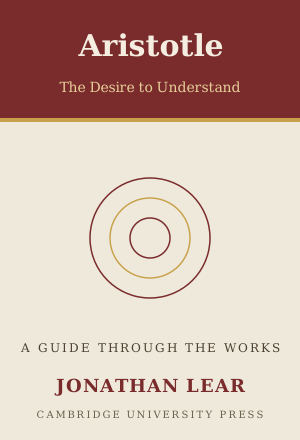
Aristotle: The Desire to Understand
The best modern study to read alongside the originals. Lear takes the opening line of the Metaphysics — "all men by nature desire to know" — as his thread, and walks you through logic, nature, soul, ethics, and being with unusual clarity and warmth. Not a summary but an argument you take part in. The bridge from having read Aristotle to genuinely understanding him.
Check price & availability on Amazon
View on Amazon Read our review -
5
 Advanced
The Metaphysics (Penguin Classics)
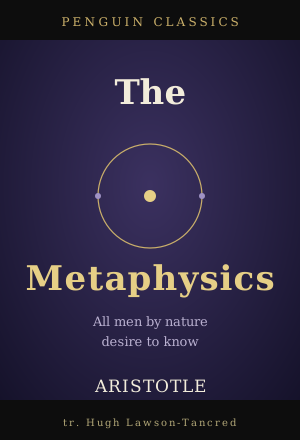
"All men by nature desire to know." The summit of the shelf and one of the foundational texts of Western philosophy. What does it mean for something to be? Substance, essence, potentiality and actuality — the concepts forged here were argued over for two thousand years. The hardest book here by a wide margin; but with the previous four behind you, its difficulty turns from a wall into a climb.
Check price & availability on Amazon / Kindle edition available
View on Amazon Read on Kindle Read our review
The 5 Books at a GlanceCOMPARE
The biggest worry with Aristotle is "can I actually finish this?" Choose by difficulty and by type — introduction, primary text, or study.
| Title | Difficulty | Length | Type | Best for | Links |
|---|---|---|---|---|---|
| The Nicomachean Ethicstr. Thomson & Tredennick · Penguin Classics | Intermediate ★★☆ | ~400 pp. | Primary (flagship) | The one Aristotle to read if you read only one | View on Amazon Review |
| Aristotle: A Very Short IntroductionJonathan Barnes · OUP | Beginner ★☆☆ | ~176 pp. | Introduction | You want the whole system mapped before the originals | View on Amazon Review |
| The Politicstr. Sinclair & Saunders · Penguin Classics | Intermediate ★★☆ | ~512 pp. | Primary | You've read the Ethics and want the companion on the city | View on Amazon Review |
| Aristotle: The Desire to UnderstandJonathan Lear · Cambridge | Intermediate ★★☆ | ~342 pp. | Modern study | You want a guide through the whole of Aristotle's thought | View on Amazon Review |
| The Metaphysicstr. Lawson-Tancred · Penguin Classics | Advanced ★★★ | ~528 pp. | Primary (summit) | You want the foundational text on being, argued in full | View on Amazon Review |
A Reading Order That Won't Defeat YouROADMAP
The two usual causes of failure with Aristotle are starting with an original like the Metaphysics and trying to memorize the technical terms (substance, potentiality, the mean) like dictionary entries. Introduction → the readable original → the second original → study and the summit. Climb in four steps.
-
STEP 1 ── Get the map first (one book)
Read Barnes's Very Short Introduction for the shape of the whole
Don't dive into an original yet. In a couple of hours Barnes shows how logic, physics, biology, ethics, politics, and metaphysics fit into one system, so that every text you meet later has a place on the map. The best insurance against getting lost in the vocabulary.
Very Short Introduction on AmazonRead on Kindle -
STEP 2 ── Read the readable original (the flagship)
Take on the Nicomachean Ethics and feel yourself reading Aristotle
The most followable of the originals, because its subjects — happiness, courage, money, anger, friendship — are close to the ground. Finish one primary text here and every later Aristotle comes nearer. This is the success that makes the rest possible.
The Nicomachean Ethics on Amazon -
STEP 3 ── Read the second original
Continue into the Politics, the companion to the Ethics
The Ethics asks how to live; the Politics asks where. Same concrete, argumentative method, applied to constitutions, revolution, and the point of the state. Reading them as a pair is how Aristotle meant them to be read.
The Politics on AmazonRead on Kindle -
STEP 4 ── Deepen, then take the summit (two books)
Lear's The Desire to Understand, then the Metaphysics
Deepen your grip with Lear's superb study, which walks the whole of Aristotle's thought argument by argument, then climb the shelf's hardest peak: the Metaphysics, on what it means for anything to be. Steps 1–3 turn its difficulty from a wall into a climb — and reaching it is the goal of this shelf.
The Desire to Understand on AmazonThe Metaphysics on Amazon
How We ChoseCRITERIA
Three criteria. First, currently in print and actually available on amazon.com — every title has a live product page from an established publisher (Penguin Classics, Oxford University Press, Cambridge University Press). Second, the ladder must hold: a short introduction for the map, the Nicomachean Ethics as the readable first original, the Politics as its companion, a modern study to deepen, and the Metaphysics as the summit — each step preparing the next. Third, honesty about what each book is: an introduction is a map, not the territory; a translation is a reading; a study is an argument, not a neutral summary. The reviews say which is which. This English edition mirrors the roles of our Japanese shelf; where a Japanese pick had no English counterpart (a domestic introduction or study), we substituted the closest respected English work and say so on the About page. The editorial room runs a family of philosopher bookshelves and a section-by-section archive of the primary texts; those first-hand readings are the foundation here.
Still Undecided? Take This OneCONCLUSION
If you have read this far and still can't choose, the answer is simple: read the Nicomachean Ethics. It is the most followable of Aristotle's originals, and its subjects — happiness, virtue, the mean, friendship — are the ones that still bear directly on how to live. Once you have it, every other Aristotle can be anchored to "the Aristotle of the Ethics." And if diving straight into an original feels daunting, spend a couple of hours with Barnes's Very Short Introduction first — that is this shelf's recommended route.
Check price & availability on the Amazon product pages