Home › Top 5 › A Very Short Introduction
Review: Aristotle: A Very Short Introduction — the whole system, mapped
★★★★★4.6 / 5.0 (editorial rating)
Verdict: the gentlest possible way in, written by one of the leading Aristotle scholars of his generation. In fewer than two hundred pages Jonathan Barnes lays out the entire system — logic, the natural sciences, metaphysics, psychology, ethics, politics, art — and, more importantly, shows how the pieces fit into a single picture of the world. Read this first and the originals stop being a maze.
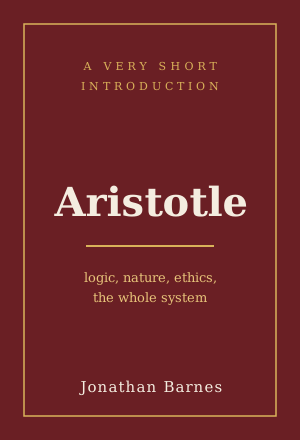
- Title
- Aristotle: A Very Short Introduction
- Author
- Jonathan Barnes
- Publisher
- Oxford University Press (Very Short Introductions)
- Length
- Introduction · ~176 pp.
- Difficulty
- Beginner ★☆☆ — no prior reading assumed
Check price & availability on the Amazon product page
What it is — in three lines
This is the Aristotle volume in Oxford's celebrated Very Short Introductions series. Rather than march through the works one by one, Barnes organizes the book around Aristotle's curiosity — the drive to understand everything — and follows it into logic, the study of nature and living things, the theory of being, the workings of the mind, and the account of the good life and the good state. The result is short, authoritative, and genuinely readable.
The core — a thinker, not a checklist
The reason to start here is that Barnes refuses to give you a list of doctrines to memorize. Instead he shows Aristotle thinking: how the same handful of tools — the four causes, matter and form, potentiality and actuality — recur across biology, physics, and metaphysics, so that a single cast of mind is at work whether he is dissecting a cuttlefish or asking what it is for something to exist. Once you see the tools, the vast body of work stops looking like a shelf of unrelated treatises and starts looking like one project. That is exactly the picture a first-time reader needs, and it is the thing the originals, read cold, hide rather than reveal. Barnes also writes with a dry wit and an unshowy command of the scholarship, so the brevity never feels like thinness.
Three highlights
1. It gives you the map before the territory
By the last page you can place any Aristotelian work — the Ethics, the Physics, the Metaphysics — on a mental map. That orientation is what keeps you from getting lost later.
2. It is honest about the difficulties
Barnes does not pretend Aristotle is easy or always right. He flags where the arguments are shaky and where scholars disagree, which is far more useful to a beginner than reverent summary.
3. It reads in an afternoon
At around 176 pages it is a single sitting. That low cost of entry is precisely why it belongs at the top of the reading order rather than buried as "further reading."
What to watch out for
One honest caveat, and it is structural: an introduction is a map, not the territory. Barnes is a superb guide, but reading about Aristotle is not the same as reading Aristotle, and this book is not a substitute for the Ethics or the Metaphysics — it is the thing that makes them approachable. Treat it as scaffolding: indispensable while you build, but not the building. Read it, then go to the originals with its map in hand.
Check price & availability on the Amazon product page