Home › Top 5 › The Desire to Understand
Review: Aristotle: The Desire to Understand — the study that walks beside you
★★★★★4.6 / 5.0 (editorial rating)
Verdict: the best modern study to read alongside the originals. Jonathan Lear takes the first sentence of the Metaphysics — "all men by nature desire to know" — as his guiding thread, and walks you through logic, nature, the soul, ethics, and being with unusual clarity and warmth. Not a summary to absorb but an argument you take part in. The bridge from having read Aristotle to genuinely understanding him.
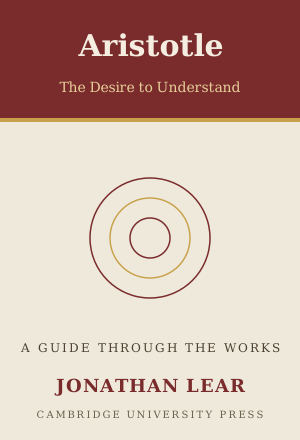
- Title
- Aristotle: The Desire to Understand
- Author
- Jonathan Lear
- Publisher
- Cambridge University Press (1988)
- Length
- Modern study · ~342 pp.
- Difficulty
- Intermediate ★★☆ — demanding but exceptionally lucid
Check price & availability on the Amazon product page
What it is — in three lines
Lear's book is a single, connected interpretation of Aristotle's philosophy, drawing on texts from the Physics, Metaphysics, Ethics, Politics, and the biological and logical works. Rather than survey the corpus, it argues a thesis: that Aristotle's whole enterprise is powered by the desire to understand, and that this single drive explains why he studies living things, change, mind, and being as parts of one project. It is written to be read actively, with the reader thinking alongside the author.
The core — one thread through everything
What makes this study special is that it refuses to chop Aristotle into separate "areas." Lear shows how the same questions run from biology up to metaphysics: what it is for a living thing to be the thing it is, how form and matter explain change, why understanding something means grasping its "for the sake of which." By keeping the thread of understanding in hand, he lets you see the Metaphysics not as an isolated summit but as the place where questions raised in the study of nature and life finally become questions about being as such. And he does it in prose that is genuinely warm — Lear is a philosopher who wants you to feel the pull of the problems, not just to file the doctrines. The effect is that difficult material (potentiality and actuality, substance, the four causes) arrives with its motivation attached, so you understand not only what Aristotle claims but why the claim seemed necessary. That is exactly what the originals, read alone, tend to withhold.
Three highlights
1. It motivates the hard concepts
Form and matter, potentiality and actuality, substance — Lear introduces each through a problem you can feel, so the vocabulary lands as a solution rather than as jargon to memorize.
2. It prepares you for the Metaphysics
Read just before the summit, this study turns the Metaphysics from an ambush into an expected destination. Half of that book's difficulty is missing context; Lear supplies it.
3. It is a pleasure to read
Academic Aristotle studies are often forbidding. This one is lucid and humane, the rare scholarly book you keep reading past the section you needed.
What to watch out for
One honest note, the governing one for this site: a study is an argument, not a neutral summary. Lear has a thesis — the primacy of "the desire to understand" — and it shapes what he emphasizes and what he sets aside; other fine scholars read Aristotle differently. That is a feature, not a flaw, but treat the book as a strong, persuasive reading to think with, not as the last word. And although it is exceptionally clear, it is still a work of philosophy: it rewards reading with an original open beside it, checking Lear's interpretation against Aristotle's own text.
Check price & availability on the Amazon product page