Home › Top 5 › Nicomachean Ethics
Review: The Nicomachean Ethics — the book that trains "how to live well"
★★★★★5.0 / 5.0 (editorial rating)
Verdict: if you read only one Aristotle, read this. It asks the largest question head-on — what is the highest good for a human being? — answers it as eudaimonia (flourishing), and grounds it in virtues built by habit and aimed at a mean between excess and deficiency. Because it thinks through anger, money, and friendship, it is the most followable of the originals: the book where you first feel that you can actually read Aristotle.
- Title
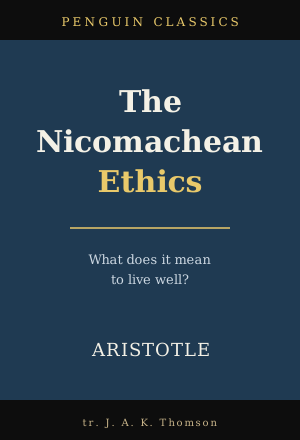
- The Nicomachean Ethics (Penguin Classics)
- Author
- Aristotle
- Translators
- J. A. K. Thomson, revised by Hugh Tredennick (introduction by Jonathan Barnes)
- Publisher
- Penguin Classics (original: 4th century BC)
- Length
- Primary source · ~400 pp.
- Difficulty
- Intermediate ★★☆ — an original, but the most readable one
Check price & availability on the Amazon product page
What it is — in three lines
The book begins from a simple observation: every human activity aims at some good, so there must be a highest good at which everything else aims. Aristotle calls it eudaimonia — usually "happiness," better rendered "flourishing" — and argues it is not pleasure or wealth but the lifelong exercise, done well, of what is distinctive to us: activity of the soul in accordance with reason. Most of the work then examines the virtues that make such a life possible, and how a person comes to have them.
The core — virtue is built by habit
The central insight is that virtue is not an inborn talent but a habit (hexis) formed by doing the right thing repeatedly. You become brave by doing brave acts and temperate by doing temperate ones; character is trained like a craft, not learned like a fact. The second key idea is the doctrine of the mean: courage lies between recklessness and cowardice, generosity between extravagance and stinginess — a virtue is the ability to hit the right point between excess and deficiency, as the situation demands. This is not a bland recommendation to be "moderate." What counts as the right point differs case by case, and seeing it takes phronesis, practical wisdom sharpened by experience. That is why, for Aristotle, ethics is not a formula to memorize but a skill at living itself — knowledge that bears directly on your everyday choices rather than floating above them.
Three highlights
1. It retrains the question "what is happiness?"
Aristotle takes the candidates for the highest good — pleasure, honour, wealth — and patiently shows why none can be it. Following that argument is the best possible exercise in re-examining whatever you have vaguely been calling "being happy."
2. Virtue and the mean actually bite on daily life
Anger, fear, money, self-regard — the material is close to the ground. Once you have the idea of "aiming at the mean," your own lopsidedness of character looks different, and the book's concepts become tools for measuring ordinary days.
3. The depth of the account of friendship
Aristotle thinks friends are indispensable to a flourishing life, and divides friendship into three kinds. His claim that the highest form wishes the friend's own good — not use or pleasure — has not aged in two thousand years.
We become just by doing just acts, temperate by doing temperate acts, brave by doing brave acts.
— Aristotle, Nicomachean Ethics II.1, 1103a34 (editorial gloss of the Greek)
What to watch out for
Two things. First, being an original, it has the peculiar rhythm of a text with roots in lecture notes: the same theme is often argued again from a new angle. The trick is to keep a map of each book's subject (happiness → virtue → the mean → friendship) so you don't lose the thread. Second, this is a translation, and a reading: the Thomson/Tredennick Penguin is smooth and reliable, but where a term is loaded — eudaimonia, phronesis — no English word is neutral. Read the translator's notes rather than trusting a single English equivalent, and the book opens up rather than hardening into jargon.
Check price & availability on the Amazon product page