Review: The Politics — where the good life is actually lived
★★★★☆4.4 / 5.0 (editorial rating)
Verdict: the companion volume to the Ethics. If the flourishing life is the goal, the city (polis) is where that life is led — which is why Aristotle calls man "by nature a political animal." He compares real constitutions, anatomizes revolution, democracy, and oligarchy, and keeps asking what a state is for. Concrete and argumentative rather than abstract, and startlingly current.
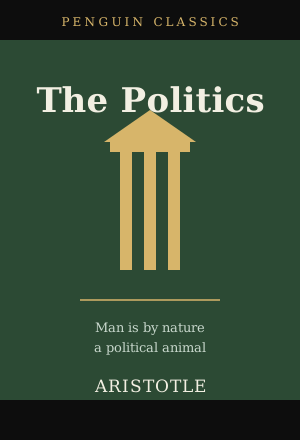
- Title
- The Politics (Penguin Classics)
- Author
- Aristotle
- Translators
- T. A. Sinclair, revised by Trevor J. Saunders
- Publisher
- Penguin Classics (original: 4th century BC)
- Length
- Primary source · ~512 pp.
- Difficulty
- Intermediate ★★☆ — concrete, but long
Check price & availability on the Amazon product page
What it is — in three lines
The Politics picks up exactly where the Ethics leaves off. Having argued that the good life is the human end, Aristotle turns to the community in which such a life is possible: the polis. He builds up from household and village to the city, argues that the city exists "for the sake of the good life" and not merely survival, and then does something strikingly empirical — he surveys and classifies actual constitutions to ask which arrangements are stable and which are just.
The core — the city completes the person
The famous claim that "man is by nature a political animal" is not a slogan but an argument: because human beings alone have reason and speech, and can debate what is just and unjust, they are only fully themselves in a community organized around those questions. From this Aristotle draws a whole method. He refuses to design a utopia from first principles; instead he collects constitutions — democratic, oligarchic, mixed — and studies how each actually works, why it decays, and what would make it more stable. The long analysis of revolution and constitutional change reads like the first work of comparative political science, sober about power, faction, and the gap between a regime's ideals and its behaviour. Where the Ethics trains the individual, the Politics asks what institutions let many individuals flourish together — and it is honest that the answer depends on circumstances, not on a single perfect blueprint.
Three highlights
1. The survey of constitutions
Aristotle's classification of who rules and in whose interest — and his account of how each form corrupts — is a template still visible in modern political theory. Reading it, you watch a discipline being invented.
2. On revolution and stability
The books on stasis (faction and upheaval) are unsentimental about why states come apart. His diagnoses of inequality and resentment as engines of instability land without adjustment on the present.
3. It completes the Ethics
Read as a pair, the two works answer one question from two sides: how should I live, and what kind of community makes that life available? Neither is whole without the other.
Man is by nature an animal made for a city; and one who is city-less by nature, and not by chance, is either beneath humanity or above it.
— Aristotle, Politics I.2, 1253a (editorial gloss of the Greek)
What to watch out for
Two things, one practical and one moral. Practically, it is long and uneven: the surviving text reads like assembled lecture material, and some books (on ideal education, left unfinished) trail off. Read for the argument, not for a tidy plan, and don't feel you must march through every chapter in order. Morally, this is a 4th-century-BC book, and it shows: Aristotle defends slavery as "natural" and assigns women a subordinate place. We do not soften that. Reading him well means engaging those arguments as arguments — seeing where the same method that yields real insight also props up the prejudices of his world — rather than either excusing them or refusing to read.
Check price & availability on the Amazon product page