ACCELERATIONISM BOOK GUIDE
The 5 Best Accelerationism Books (2026)
— from Capitalist Realism to Nick Land, in reading order
Accelerationism begins from a deliberately provocative wager: that the way out of capitalism is not to slow it down, resist it, or return to something older, but to push its most disruptive tendencies — technology, abstraction, automation — all the way through. From there the current splits sharply. A left accelerationism wants to repurpose the productive forces capitalism unleashed toward a post-work, post-scarcity future; a right accelerationism, associated above all with Nick Land, drives toward anti-democratic and reactionary conclusions. This site is not here to cheer either side or to condemn it. It is here to help you understand the argument accurately — five books, from an accessible entry point to the difficult primary texts, in an order that actually works.
The editorial room behind this site runs a family of philosopher and theme bookshelves with one consistent rule: pick the wrong first book and readers walk away from an idea for good. If you want to widen out from accelerationism to contemporary thought and political philosophy in general, our Philosophy Bookshelf takes it from there. Every recommendation here is honest about what each book is — an introduction, an anthology, a programme, a critique, or a primary source.
Our RankingRANKING
The editorial order. If you can't decide, start at #1. The idea is to hold a map of the current before you take on the primary texts. Check prices and availability on the Amazon product pages.
-
1
 If in doubt, start hereBeginner
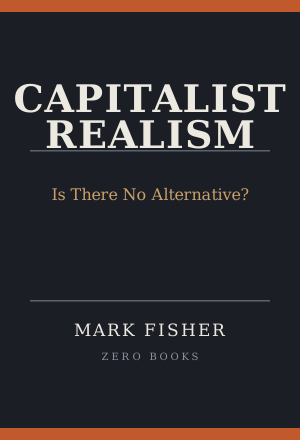
Capitalist Realism: Is There No Alternative?
The most accessible way into the whole conversation. Fisher's short, sharp essay names the mood accelerationism reacts against: the sense that "it is easier to imagine the end of the world than the end of capitalism." Under a hundred pages, written for the general reader, and the ideal place to feel the problem before you meet the theory.
Check price & availability on Amazon / Kindle edition available
View on Amazon Read on Kindle Read our review -
2
 Intermediate
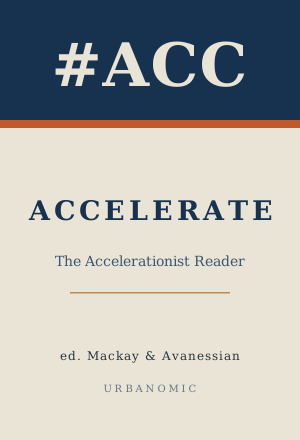
#Accelerate: The Accelerationist Reader
The single-volume map of the whole current. The editors' long introduction traces the genealogy from Marx's "Fragment on Machines" through the 1970s to today, and the anthology then collects the key texts — including Land's early essays and the Srnicek–Williams manifesto — left and right in one place. The overview and the sourcebook at once.
Check price & availability on Amazon
View on Amazon Read our review -
3
 Intermediate
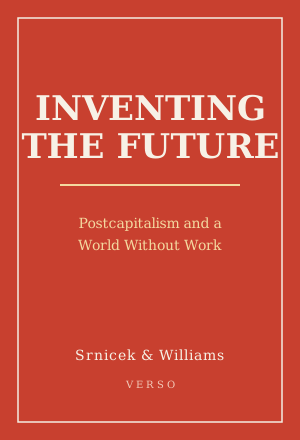
Inventing the Future: Postcapitalism and a World Without Work
The book-length case for the left-accelerationist project. Srnicek and Williams argue for full automation, a universal basic income, and a shorter working week — a positive programme built on the technologies capitalism produced, aimed past it rather than back before it. The most constructive, policy-facing book on the shelf.
Check price & availability on Amazon / Kindle edition available
View on Amazon Read on Kindle Read our review -
4
 Advanced
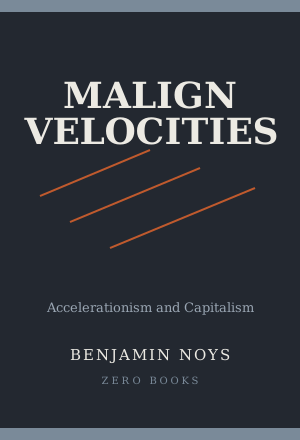
Malign Velocities: Accelerationism and Capitalism
The critical counterweight — and the book that put the word "accelerationism" into wide circulation. Noys is a sharp opponent of the tendency, tracing it from Italian Futurism through 1970s theory to the post-2008 moment and arguing that speeding up capitalism mistakes the disease for the cure. Read it to stress-test everything above.
Check price & availability on Amazon / Kindle edition available
View on Amazon Read on Kindle Read our review -
5
 Advanced
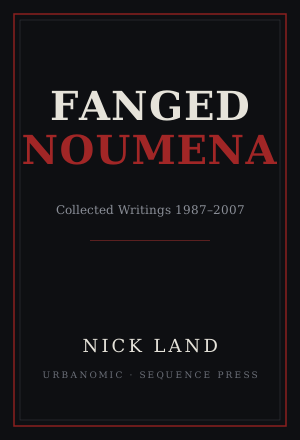
Fanged Noumena: Collected Writings 1987–2007
The primary source, and the hardest book here. This is the collected writing that made Land a cult figure and seeded the "dark" strand of accelerationism — dense, deliberately unsettling "theory-fiction" that fuses Kant, Bataille and cybernetics. Provocative and often extreme; we place it here to be read accurately, once you have the map, not first.
Check price & availability on Amazon
View on Amazon Read our review
The 5 Books at a GlanceCOMPARE
The biggest worry with accelerationism is starting with a difficult primary text and stalling — or absorbing extreme claims with no sense of where they sit. Choose by difficulty and type.
| Title | Difficulty | Length | Type | Best for | Links |
|---|---|---|---|---|---|
| Capitalist RealismMark Fisher · Zero Books | Beginner ★☆☆ | ~80 pp. ~3 hrs |
Entry essay | First contact; you want to feel the problem before the theory | View on Amazon Review |
| #Accelerate: The Accelerationist Readered. Mackay & Avanessian · Urbanomic | Intermediate ★★☆ | 544 pp. selective |
Anthology + overview | You want the whole map and the key texts in one volume | View on Amazon Review |
| Inventing the FutureSrnicek & Williams · Verso | Intermediate ★★☆ | ~250 pp. ~6 hrs |
Left-accel programme | You want the constructive, post-work argument in full | View on Amazon Review |
| Malign VelocitiesBenjamin Noys · Zero Books | Advanced ★★★ | ~120 pp. ~4 hrs |
Critical study | You want the strongest case against accelerationism | View on Amazon Review |
| Fanged NoumenaNick Land · Urbanomic / Sequence Press | Advanced ★★★ | ~640 pp. weeks |
Primary source | You want Land's own writing, read with a map in hand | View on Amazon Review |
A Reading Order That Won't Defeat YouROADMAP
There is essentially one way to get defeated by accelerationism: opening a primary text first. Land's Fanged Noumena — and even the denser stretches of the Reader — will strand you at the level of style if you meet them without the map: the left/right split, and the question the whole current is answering. Feel the problem, take the map, then choose your primary source. Climb in three steps.
-
STEP 1 ── Feel the problem (one book)
Read Fisher's Capitalist Realism
Under a hundred pages, written for the general reader. Why has it become so hard to imagine anything outside capitalism? That closed horizon is exactly the wall accelerationism sets out to break — so this is the mood the rest of the shelf argues with. The perfect on-ramp.
Capitalist Realism on AmazonRead on Kindle -
STEP 2 ── Take the map, then pick a side to study (books 2–3)
The Reader for the whole genealogy, Inventing the Future for the left programme
The Accelerationist Reader gives you the genealogy and the key texts, left and right, in one volume — read the editors' introduction even if you only dip into the rest. Then Inventing the Future lays out the constructive left-accelerationist case at book length. Now you can see what is actually being argued, and by whom.
The Reader on AmazonInventing the Future on Amazon -
STEP 3 ── The critique, then the primary source (the goal)
Test it with Malign Velocities, then take on Fanged Noumena
With the map in hand, read Noys's Malign Velocities as the sharpest case against the whole tendency — then, if you want the dark primary source itself, Land's Fanged Noumena. It is provocative and often extreme; read it as an argument to be understood, judgement held open, one essay at a time. From here, our Philosophy Bookshelf widens the view to contemporary thought at large.
Malign Velocities on AmazonFanged Noumena on Amazon
How We ChoseCRITERIA
Three criteria. First, currently in print and actually available on amazon.com — every title has a live product page from an established publisher (Zero Books, Urbanomic, Verso, Sequence Press). Second, the ladder must hold: feel the problem → take the map → study the left programme → weigh the critique → read the primary source, each step preparing the next, with an entry point as gentle as a hundred-page essay and a summit as demanding as Land's collected writings. Third, honesty about what each book is and where it stands. Accelerationism runs from a constructive left project to Nick Land's reactionary, anti-democratic "dark" strand, and the books here include both a sympathetic programme and its sharpest critic. We neither celebrate nor condemn a political position; our aim is that you understand the argument accurately, and every review flags a book's difficulty and its controversies plainly. Difficulty ratings are the editorial room's own, not reproductions of Amazon reviews; the grounds for each rating are stated in the review's editorial note.
Still Undecided? Take This OneCONCLUSION
If you have read this far and still can't choose, the answer is simple: start with Capitalist Realism. In under a hundred pages Mark Fisher names the closed horizon — "it is easier to imagine the end of the world than the end of capitalism" — that everything else on this shelf is trying to break open. Once that problem is under your skin, the Reader, the left programme, the critique and even Land's primary texts all have somewhere to land. Accelerate, or exit? You cannot weigh the question until you have felt the wall.
Check price & availability on the Amazon product pages