Home › Top 5 › Capitalist Realism
Review: Capitalist Realism — the best on-ramp to accelerationism
★★★★★4.6 / 5.0 (editorial rating)
Verdict: the single best place to begin. In under a hundred pages, Mark Fisher gives a name to the very wall that accelerationism sets out to break — the feeling that there is simply no alternative to capitalism — and he does it in plain, vivid prose drawn from films, work and everyday life. It is not itself an accelerationist manifesto, but nothing prepares you for the argument better. Read this first, and the harder books later have somewhere to land.
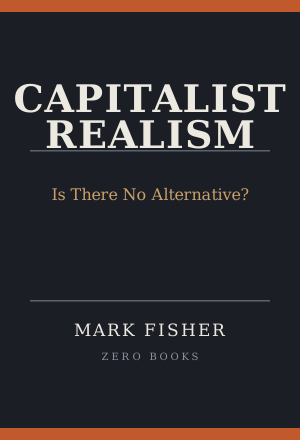
- Title
- Capitalist Realism: Is There No Alternative?
- Author
- Mark Fisher
- Publisher
- Zero Books (2009)
- Length
- Entry essay · ~80 pp.
- Difficulty
- Beginner ★☆☆ — reads in an afternoon
Check price & availability on the Amazon product page
What it is — in three lines
Mark Fisher (1968–2017) was a British writer and theorist, a co-founder of Zero Books, and a figure with deep roots in the same 1990s Warwick milieu — the CCRU — that also produced Nick Land. Capitalist Realism is his best-known book: a compact essay diagnosing what he calls "capitalist realism," the widespread sense that capitalism is not just the only viable system but the only one we can even imagine. Drawing on films, mental health, bureaucracy and education, it argues that this closed horizon shapes almost all of contemporary experience.
Why it is the right first book
The reason is that it hands you the problem before it hands you any theory. Accelerationism, in all its variants, is a response to exactly the impasse Fisher describes — if you cannot get outside capitalism by resisting or escaping it, perhaps the only way out is through. You do not need to have decided anything about that wager to feel the force of the wall. Fisher makes the wall concrete, and he does it in short, punchy chapters with no jargon and a lot of pop culture.
It has become easier to imagine the end of the world than to imagine the end of capitalism — and that failure of imagination is itself the thing to be explained. (editorial paraphrase of the book's central claim)
— the guiding idea of Capitalist Realism (editorial paraphrase)
You can read it straight through in an afternoon, yet you close it holding the question the rest of this shelf argues over. For an entry point into a difficult current of thought, that ratio of readability to stakes is rare.
Three highlights
1. It names the mood, not just the theory
Fisher's gift is to give a precise name to something diffuse — the resigned "there is no alternative" that saturates work and culture. Once named, it is impossible to un-see, and every later book on this shelf is legible as a different attempt to break it.
2. It reads through films and everyday life
Rather than argue in the abstract, Fisher works through cinema, call-centre bureaucracy, education and mental health. The theory arrives already attached to things you recognise, which is why the book travels so far beyond the seminar room.
3. It sets up the left/right stakes
Because Fisher shared the Warwick lineage with Nick Land but drew radically different, left-egalitarian conclusions, this book is also the cleanest way to feel why the same starting point can fork toward opposite politics — the split you will meet head-on in the Reader.
What to watch out for
Two honest notes. First, this is not a book about accelerationism as such — Fisher does not use it as a banner, and you will not find the left/right taxonomy laid out here. It is the diagnosis the accelerationists respond to, which is exactly why it belongs first, but do not expect it to define the term. Second, it is very much of its post-2008 moment, thick with late-2000s British references; the argument outlives them, but some examples will feel dated. Take the frame, not the footnotes.
Check price & availability on the Amazon product page