Home › Top 5 › #Accelerate: The Accelerationist Reader
Review: #Accelerate: The Accelerationist Reader — the map and the sources in one volume
★★★★★4.5 / 5.0 (editorial rating)
Verdict: the definitive single-volume way to see the whole current. Robin Mackay and Armen Avanessian open with a long, careful introduction that traces the genealogy of accelerationism from Marx to the present, then hand you the key primary texts — left and right — collected in one 544-page book. It is both the map and the sourcebook; you do not read it cover to cover so much as navigate it. If you buy one book that shows you the terrain, this is it.
- Title
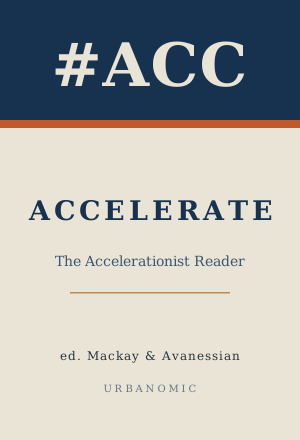
- #Accelerate: The Accelerationist Reader
- Editors
- Robin Mackay & Armen Avanessian
- Publisher
- Urbanomic (2014; distributed with MIT Press)
- Length
- Anthology · 544 pp.
- Difficulty
- Intermediate ★★☆ — accessible framing, demanding sources
Check price & availability on the Amazon product page
What it is — in three lines
Edited by Robin Mackay (founder of the philosophy press Urbanomic) and Armen Avanessian, this is the anthology that consolidated "accelerationism" as a named field. It gathers an "anticipations" section of precursors — including Marx's famous "Fragment on Machines" — a "ferment" of late-twentieth-century texts, and a "current" of recent statements, framed throughout by the editors' substantial introductory essay. Roughly two dozen texts, spanning the left and right poles of the tendency, in one volume.
Why it is the map of the whole current
What makes the Reader indispensable is the editors' introduction. Rather than treat accelerationism as a single doctrine, it lays out a genealogy: how a strand within Marx, refracted through Deleuze and Guattari, the 1990s Warwick CCRU, and the post-2008 left, splits into rival programmes that share a starting move — do not slow capitalism down; push through it. With that scaffolding in place, the anthology's primary texts stop being a wall of difficulty and become points you can locate on a map.
The radical response to capitalism is not to resist, protest, or withdraw, but to press its most dynamic, uprooting tendencies further and faster than capital itself dares. (editorial paraphrase of the anthology's framing thesis)
— the editors' framing of accelerationism (editorial paraphrase)
Crucially, the book is even-handed by design: it prints the left-accelerationist manifesto and Land-adjacent material side by side, so you can see the fork for yourself rather than take anyone's summary of it. That is exactly what a first survey of a contested field should do.
Three highlights
1. The introduction is a course in itself
Read nothing else and the editors' essay still gives you the clearest short history of the current available in English — where it comes from, why it divides, and what is at stake.
2. Precursors you would never assemble yourself
Placing Marx's "Fragment on Machines" at the head of a lineage that runs to the present reframes accelerationism as an old question about technology and labour, not a recent internet curiosity.
3. Left and right in one binding
Because it refuses to pick a side editorially, the anthology lets you compare the constructive left programme and the darker Landian strand directly — the honest way to meet a divided field.
What to watch out for
Two honest notes. First, this is an anthology, not a monograph: the individual texts vary wildly in difficulty and were written for different audiences, so do not expect a smooth read from front to back. Use the introduction as your guide and move around. Second, some of the collected pieces — particularly the earlier Land material — are deliberately provocative and stylistically extreme; the point of reading them in this framed, comparative setting is precisely that you meet them with context rather than in isolation. Newcomers should read Fisher's Capitalist Realism first for the mood.
Check price & availability on the Amazon product page