Home › Top 5 › Inventing the Future
Review: Inventing the Future — the left-accelerationist programme in full
★★★★☆4.3 / 5.0 (editorial rating)
Verdict: the constructive pole of accelerationism, argued at book length. Srnicek and Williams take the impulse behind their earlier manifesto and turn it into a concrete political programme: full automation, a universal basic income, a shorter working week, and the deliberate building of a post-work future on the technologies capitalism produced. It is the most positive, policy-facing book on the shelf — and the clearest picture of what "left accelerationism" actually proposes.
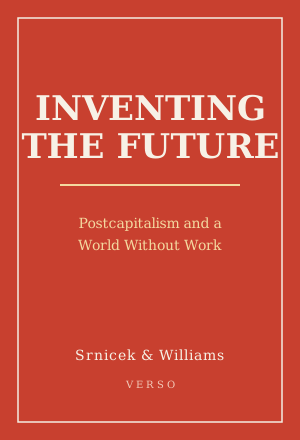
- Title
- Inventing the Future: Postcapitalism and a World Without Work
- Authors
- Nick Srnicek & Alex Williams
- Publisher
- Verso (revised and updated edition)
- Length
- Political programme · ~250 pp.
- Difficulty
- Intermediate ★★☆ — clear prose, some theory and policy
Check price & availability on the Amazon product page
What it is — in three lines
Nick Srnicek and Alex Williams are the authors of the 2013 "#Accelerate: Manifesto for an Accelerationist Politics," the text that named the left pole of the current. Inventing the Future is the full development of that project. It argues that the left has retreated into small-scale, defensive "folk politics," and that it should instead reclaim ambition and modernity — demanding full automation, a universal basic income, the reduction of the working week, and an end to the work ethic as a moral demand.
Why it is the constructive core
Where much of the current diagnoses or provokes, this book proposes. Its wager is squarely accelerationist in the left sense: the automation and productive power that capitalism generated should not be resisted but steered past capitalism, toward a world where work is no longer the centre of life. The authors pair that vision with strategy — the need to build counter-hegemonic institutions, to think at scale, and to recover a confident idea of the future from a left they see as stuck defending the present.
Automation should not be feared but demanded: let the machines do the work, cut the working week, guarantee an income, and free people from the compulsion to labour. (editorial paraphrase of the book's core demands)
— the programme of Inventing the Future (editorial paraphrase)
Notably, the final book downplays the word "accelerationism" itself, which had become a lightning rod; but the DNA is unmistakable, and reading it after the Reader shows you what the left manifesto looks like once it grows into a full argument.
Three highlights
1. A positive vision, not just critique
After several books diagnosing an impasse, it is bracing to read one that says clearly what it wants — a post-work society — and argues for the mechanisms to get there.
2. The critique of "folk politics"
The authors' charge that much contemporary activism prefers the small, local and immediate over the systemic is provocative and genuinely useful, whether or not you accept it.
3. It grounds accelerationism in policy
Universal basic income, automation and working-time reduction are live public debates; the book connects the abstract current to arguments you can actually take a position on.
What to watch out for
Two honest notes. First, this is the left pole only — it is a partisan programme, not a neutral survey, and it makes no attempt to represent the Landian right strand. That is a strength for understanding left accelerationism, but do not mistake it for the whole field. Second, the argument is contested on its own terms: critics question whether automation delivers the post-scarcity it promises, and whether the strategy scales. Read it alongside its critics — most directly Noys's Malign Velocities — rather than as the last word.
Check price & availability on the Amazon product page