Home › Top 5 › Malign Velocities
Review: Malign Velocities — the case against accelerationism
★★★★☆4.2 / 5.0 (editorial rating)
Verdict: the essential counterweight. Benjamin Noys is the theorist who put the term "accelerationism" into wide circulation — as a critic — and this short book is his sustained case against it. He tracks the impulse across a century, from Italian Futurism and revolutionary-era enthusiasm through 1970s theory to the post-2008 revival, and argues that accelerating capitalism confuses the disease for the cure. Read it to stress-test everything else on the shelf; a current is only as strong as its best objection.
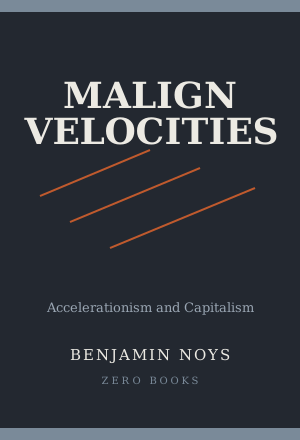
- Title
- Malign Velocities: Accelerationism and Capitalism
- Author
- Benjamin Noys
- Publisher
- Zero Books (2014)
- Length
- Critical study · ~120 pp.
- Difficulty
- Advanced ★★★ — short but theoretically dense
Check price & availability on the Amazon product page
What it is — in three lines
Benjamin Noys is a theorist who coined "accelerationism" in its current critical usage (in his earlier book The Persistence of the Negative) and remained its most incisive opponent. Malign Velocities is his book-length reckoning with the tendency: a genealogy and a critique in one, arguing that the fantasy of riding capitalism's speed to a way out is a recurring, and recurringly mistaken, response to the pain of labour under capital. Short, learned, and pointed.
Why the critique matters
Every serious current needs its strongest objection read alongside it, and Noys supplies accelerationism's. His argument is not that speed and technology are irrelevant, but that the accelerationist wager — push capitalism harder and it breaks toward liberation — repeatedly mistakes intensification for emancipation, aestheticising the very exhaustion and misery it claims to overcome. He reads the tendency as a symptom to be understood, tracing how the same seductive move resurfaces from the Futurists to the present.
The dream that we can ride capitalism's acceleration all the way out the other side mistakes the intensification of our suffering for the path to its end. (editorial paraphrase of Noys's central objection)
— the core argument of Malign Velocities (editorial paraphrase)
Reading it after the left programme of Inventing the Future is deliberately uncomfortable: it turns the shelf into an argument rather than a set of endorsements, which is exactly the point of a neutral guide.
Three highlights
1. The long history of the impulse
Noys's genealogy — Futurism, the revolutionary 1920s, 1970s "desiring" theory, cyberpunk, post-2008 — shows accelerationism as an old temptation, not a novelty, which reframes the whole debate.
2. It names the aesthetic seduction
His sharpest move is to expose how the rhetoric of speed and intensity does emotional work, making misery feel like momentum. Once you see it, you read every manifesto more carefully.
3. It keeps the shelf honest
Placed against the sympathetic books, this one guarantees you are weighing a case, not absorbing a creed — indispensable for a reader who wants to judge accelerationism rather than join it.
What to watch out for
Two honest notes. First, it is a critique, and wears its position openly — Noys is against accelerationism, so read him as the prosecution, not an umpire. That is precisely his value here, but pair him with the pro-side books rather than treating either as neutral. Second, though short, the book is theoretically dense, assuming familiarity with the Marxist and continental vocabulary the tendency grew from; this is why we rate it Advanced despite its length, and why it belongs after the map, not before it.
Check price & availability on the Amazon product page