Review: Fanged Noumena — the dark primary source, read with a map
★★★★☆4.0 / 5.0 (editorial rating)
Verdict: the primary source, and the summit of this shelf. These collected writings are what made Nick Land a cult figure and seeded the "dark," reactionary strand of accelerationism. The prose is deliberately difficult "theory-fiction" — Kant, Bataille and cybernetics smeared into something feverish and deliberately unsettling — and the politics that later grew from it are anti-democratic and widely rejected. We place it last, and rate it as a document to be understood, not endorsed: read it accurately, with judgement held open, once you have the map.
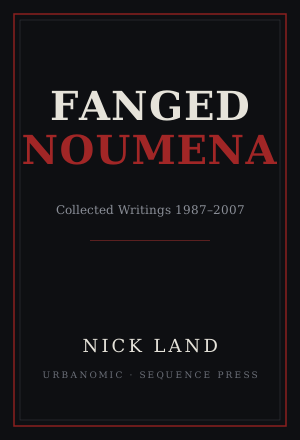
- Title
- Fanged Noumena: Collected Writings 1987–2007
- Author
- Nick Land (ed. Robin Mackay & Ray Brassier)
- Publisher
- Urbanomic / Sequence Press (2011)
- Length
- Primary source (collected writings) · ~640 pp.
- Difficulty
- Advanced ★★★ — the hardest book on the shelf
Check price & availability on the Amazon product page
What it is — in three lines
Nick Land is a British philosopher who, in the 1990s at the University of Warwick and its offshoot the CCRU, produced a body of radical, hybrid writing before largely disappearing from academic view; he later became associated with the "neoreactionary" or "Dark Enlightenment" tendency. Fanged Noumena, edited by Robin Mackay and Ray Brassier, collects two decades of that work in one volume — from early rereadings of Kant, Nietzsche and Bataille, through the mid-1990s theory-fictions of runaway cybernetic capitalism, to the cryptic later texts. It is widely credited with fuelling accelerationism's rise.
Why it is the primary source
If the other books describe, program, or critique accelerationism, this is the thing itself in its rawest, most influential form. Land's writing does not argue in the ordinary sense; it stages the acceleration it talks about, pushing philosophical prose toward breakdown to enact a vision of capital as an inhuman, self-propelling process. Reading it explains why the current has the intensity — and the danger — it does, in a way no summary can. That is the case for meeting it firsthand.
Capital is not a tool humanity uses but a runaway process that uses humanity — an intelligence assembling itself out of markets and machines, indifferent to us. (editorial paraphrase of a recurring Landian theme)
— a recurring motif across Fanged Noumena (editorial paraphrase)
It is also, bluntly, the shelf's hardest read: dense, allusive, and written to resist paraphrase. This is exactly why it comes last — with the map from the Reader and the critique from Malign Velocities already in hand, the difficulty becomes navigable rather than defeating.
Three highlights
1. The origin of "dark" accelerationism
Here is where the reactionary strand's imagery and intensity come from. Whatever you conclude about it, understanding the current means understanding this source.
2. Theory-fiction as method
Land's fusion of philosophy, science fiction and cybernetics is a genuine formal experiment; even readers who reject his conclusions find the writing unlike anything else in recent theory.
3. It rewards the climb
Approached last, with context, the collection pays back the effort — you finally see the raw material that the maps, programmes and critiques were all responding to.
What to watch out for
This book needs its warnings stated plainly. First, the politics. Land's later trajectory is associated with anti-democratic, "neoreactionary" positions that are widely and, in our view, rightly rejected; parts of this writing are deliberately provocative and can be genuinely disturbing. We include it as the primary source a serious reader must reckon with, not as an endorsement — this site takes no side, and understanding an argument is not agreeing with it. Second, the difficulty. Do not start here; without the earlier books you will meet only the style. Read it slowly, one essay at a time, and keep the critique nearby so you are weighing the text, not swept along by it.
Check price & availability on the Amazon product page