WATSUJI TETSURO BOOK GUIDE
The 5 Best Watsuji Tetsurō Books (2026)
— from Climate and Culture to the ethics of betweenness, in reading order
Watsuji Tetsurō (1889–1960) is the philosopher who answered Heidegger's Being and Time by asking what its long meditation on time had left out: space, climate, and the fact that a human being is never simply an individual but always a person between persons. His masterwork on ethics is demanding, and readers who open it first often close it again. But Watsuji has a staircase you can actually climb. Start with the vivid Climate and Culture and his youthful travel diary, orient yourself with a short history of Japanese philosophy, and only then take on Rinrigaku, the ethics of "betweenness." Five real English editions, in an order that works.
The editorial room behind this site runs a family of philosopher bookshelves — for example The Philosophy Bookshelf and Socrates — and, in Japanese, a shelf on Watsuji built from first-hand reading of the originals. This English edition uses only real translations and studies currently on amazon.com; where the Japanese shelf pointed to a Japan-only book, we substitute the closest respected English work and say so.
Our RankingRANKING
The editorial order. If you can't decide, start at #1. Check prices and availability on the Amazon product pages.
-
1
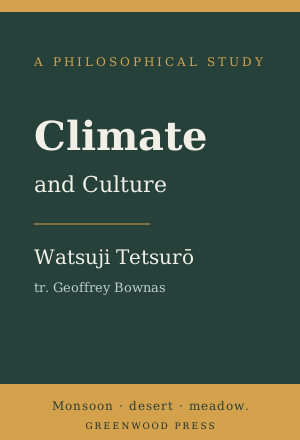 If in doubt, start hereIntermediate (masterwork)
Climate and Culture: A Philosophical Study
Watsuji's most famous and most accessible book, written after his years in Europe. He argues that human existence is bound up with fūdo — "climate" in the widest sense — and sketches three types (monsoon, desert, and meadow) to show how a place shapes the way people feel, live, and think. Concrete, readable, and the clearest single door into his thought.
Check price & availability on Amazon
View on Amazon Read our review -
2
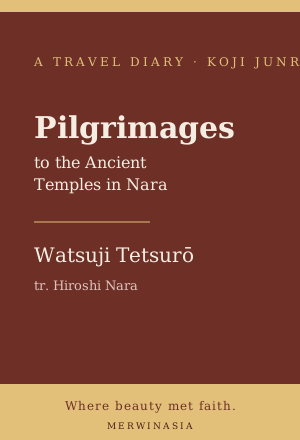 Beginner
Pilgrimages to the Ancient Temples in Nara
The English translation of Koji Junrei, the record of a trip the young Watsuji took in 1918 to the Buddhist temples of Nara. It is Watsuji before the systematic philosophy — a writer of unusual sensitivity responding to sculpture, painting, and old architecture. The gentlest way to meet him, and to see where his lifelong attention to beauty and culture began.
Check price & availability on Amazon
View on Amazon Read our review -
3
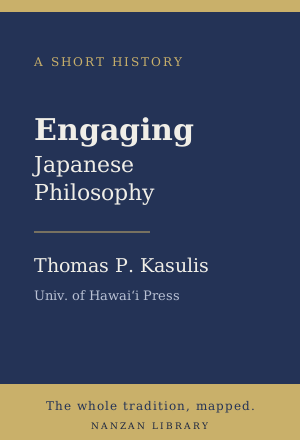 IntermediateBest for context
Engaging Japanese Philosophy: A Short History
The best single orientation in English to the tradition Watsuji belongs to. Kasulis writes as a teacher, tracing Japanese philosophy from its beginnings to the twentieth century and giving Watsuji his own substantial treatment. Read the relevant chapters and Watsuji's key terms — fūdo, aidagara ("betweenness"), ningen — stop being jargon and become ideas. A guide, not a primary text, and we treat it as one.
Check price & availability on Amazon
View on Amazon Read our review -
4
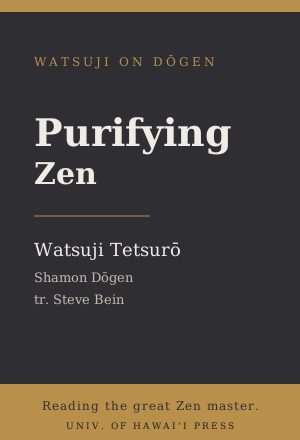 Advanced
Purifying Zen: Watsuji Tetsurō's Shamon Dōgen
Watsuji's own study of the great Zen master Dōgen — the essay that helped return Dōgen to modern Japanese thought as a philosopher, not only a religious founder. In Steve Bein's translation, with a full introduction, it shows Watsuji reading a classic of Japanese culture from the inside: the same cultural-history method that runs through all his work, applied to a single towering figure.
Check price & availability on Amazon
View on Amazon Read our review -
5
 Advanced (magnum opus)
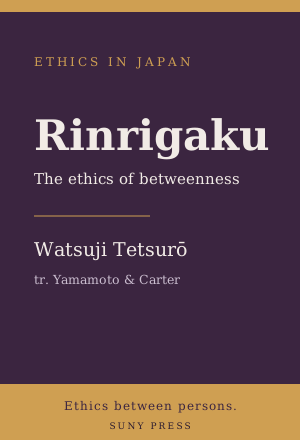
Watsuji Tetsurō's Rinrigaku: Ethics in Japan
Watsuji's central work of ethics, and the reason to make the climb. Against the Western picture of morality as the inner life of a solitary individual, he argues that ethics arises in aidagara — the "betweenness" of persons — and finds in the Japanese word ningen the double nature of self and society. This SUNY translation (an abridgement of the three-volume original) is the standard English text.
Check price & availability on Amazon
View on Amazon Read our review
The 5 Books at a GlanceCOMPARE
The biggest worry with Watsuji is "is the ethics too hard to start with?" Choose by difficulty and by type — masterwork, travel diary, orientation, study, and the ethics itself.
| Title | Difficulty | Length | Type | Best for | Links |
|---|---|---|---|---|---|
| Climate and CultureWatsuji, tr. Bownas · Greenwood | Intermediate ★★☆ | ~235 pp. ~7 hrs |
Primary (masterwork) | Reading one Watsuji, if only one | View on Amazon Review |
| Pilgrimages to the Ancient Temples in NaraWatsuji, tr. Hiroshi Nara · MerwinAsia | Beginner ★☆☆ | ~225 pp. ~6 hrs |
Travel diary (early work) | Meeting Watsuji the writer first | View on Amazon Review |
| Engaging Japanese PhilosophyThomas P. Kasulis · Hawai‘i | Intermediate ★★☆ | ~773 pp. read by chapter |
Orientation (history) | Placing Watsuji in the tradition | View on Amazon Review |
| Purifying Zen: Shamon DōgenWatsuji, tr. Bein · Hawai‘i | Advanced ★★★ | ~174 pp. ~6 hrs |
Study (Watsuji on Dōgen) | Watsuji's cultural history at work | View on Amazon Review |
| Rinrigaku: Ethics in JapanWatsuji, tr. Yamamoto & Carter · SUNY | Advanced ★★★ | ~393 pp. 3–5 weeks |
Primary (magnum opus) | The ethics of betweenness, in full | View on Amazon Review |
A Reading Order That Won't Defeat YouROADMAP
People bounce off Watsuji for two reasons: starting with the ethics before meeting the ideas that give it life, and trying to memorise "climate," "betweenness," and "ningen" as terms before seeing them at work. The accessible masterwork → a gentle first taste → orientation and a study → the ethics itself. Climb in four steps.
-
STEP 1 ── Get a taste (one book)
Begin with the travel diary, or dive straight into Climate and Culture
Don't open the ethics yet. Either meet Watsuji the writer in the Pilgrimages to the Ancient Temples in Nara — a few hours of unforced, sensitive prose — or go straight to Climate and Culture, his most famous book, where the ideas arrive with concrete examples rather than technical terms. The point is to dissolve the idea that Watsuji is only difficult.
Pilgrimages on Amazon -
STEP 2 ── Read the masterwork (the core idea)
Take on Climate and Culture
The masterwork, and the clearest statement of Watsuji's central move: a human being is never abstract but always placed — in a climate, a landscape, a way of life. Monsoon, desert, and meadow give you the whole picture in one readable book. Finish this and you have the core of his philosophy in his own words, and the successful experience of reading one Watsuji end to end.
Climate and Culture on Amazon -
STEP 3 ── Widen the field
Orient with Kasulis, and see the method in Purifying Zen
Now place Watsuji in his tradition with Kasulis's Engaging Japanese Philosophy, reading the chapters that bear on him, and watch his cultural-history method at work on a single figure in Purifying Zen, his study of the Zen master Dōgen. Both make the leap to the ethics far shorter.
Kasulis on AmazonPurifying Zen on Amazon -
STEP 4 ── The ethics itself (the goal)
Rinrigaku, the ethics of betweenness
Now the magnum opus. With the core in hand, Rinrigaku stops being a wall and becomes the payoff: ethics not as the private conscience of an isolated self but as something that arises between people. In an age that takes the individual for granted, it reads as a live challenge — and reaching it is where this shelf was always heading.
Rinrigaku on AmazonRead our review
How We ChoseCRITERIA
Three criteria. First, currently in print and actually available on amazon.com — every title has a live product page from an established publisher (Greenwood, SUNY Press, the University of Hawai‘i Press, MerwinAsia). Second, the ladder must hold: a gentle first taste → the accessible masterwork → orientation and a study → the ethics itself, each step preparing the next, with an entry point at every height. Third, honesty about what each book is: four of the five are Watsuji's own writing (the travel diary, Climate and Culture, Purifying Zen, and Rinrigaku); the fifth, Kasulis, is a modern history and orientation, not a primary text, and the reviews say so. Because Watsuji's Japanese Spiritual History and his essay collections are not available in English, we substitute the closest respected English works — his own Purifying Zen for the cultural-history role, and Kasulis for context. The Japanese-language shelf that stands behind this one is built from first-hand reading of the originals.
Still Undecided? Take This OneCONCLUSION
If you have read this far and still can't choose: start with Climate and Culture. It is Watsuji's most famous book and his most accessible — the three types of climate carry his whole way of seeing human life, and the examples make the ideas concrete on the first reading. If even that feels like a leap, warm up with the Pilgrimages to the Ancient Temples in Nara first, and meet the writer before the philosopher. That is this shelf's recommended route; everything else builds from there.
Check price & availability on the Amazon product pages