Home › Top 5 › Engaging Japanese Philosophy
Review: Engaging Japanese Philosophy — the best way to place Watsuji
★★★★★4.6 / 5.0 (editorial rating)
Verdict: the one book to read around Watsuji rather than by him. Kasulis writes a history of Japanese philosophy that is also a training in how to read it, and his chapters on the modern period give Watsuji his due while showing what he grew out of. Read the relevant parts and fūdo, aidagara, and ningen stop being foreign jargon and become ideas you can use. A guide, and we treat it as one.
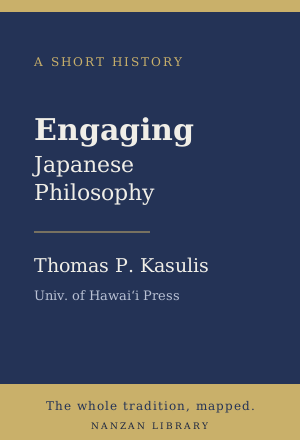
- Title
- Engaging Japanese Philosophy: A Short History
- Author
- Thomas P. Kasulis
- Publisher
- University of Hawai‘i Press (Nanzan Library of Asian Religion and Culture)
- Length
- ~773 pp. (read by chapter)
- Difficulty
- Intermediate ★★☆ — a reference to read in parts
Check price & availability on the Amazon product page
What it is — in three lines
Thomas P. Kasulis — a leading interpreter of Japanese thought for English readers — traces the whole arc of Japanese philosophy, from its beginnings through the medieval Buddhist thinkers to the modern encounter with the West and the twentieth century. Despite "short" in the title, it is a big, generous book (roughly 770 pages), written to be read a chapter at a time. It is the standard one-volume orientation, and it gives Watsuji, alongside Nishida and the Kyoto School, a serious modern-period treatment.
The core — a history that teaches you to read
What sets the book apart is its method. Kasulis doesn't just summarise doctrines; he tries to show how each thinker was engaging their world — what problem they were solving and from what standing-point — so that ideas that can look exotic become intelligible from the inside. For a reader coming to Watsuji, that is exactly the missing piece: you see how his ethics of "betweenness" answers a long Japanese conversation about self, relation, and belonging, rather than dropping from nowhere. The relevant chapters make the leap to Rinrigaku far shorter.
To understand a philosophy is to understand what it was engaging — the world it answered, not only the propositions it left behind.
— on the guiding idea of Kasulis's Engaging Japanese Philosophy
Used this way — as orientation, read in the parts that bear on Watsuji — it earns its place on the shelf.
Three highlights
1. Watsuji in context
The modern chapters set Watsuji beside Nishida and the Kyoto School and against the backdrop of Japan's meeting with Western philosophy — the frame that makes his moves legible.
2. The terms, demystified
Kasulis is unusually good at rendering Japanese philosophical vocabulary in plain English without flattening it, which is precisely what a first-time reader of Watsuji needs.
3. A book you keep
As a reference it outlasts this shelf: whenever you read further into Japanese thought, it is the volume you return to for bearings.
What to watch out for
Two honest notes. First, this is a study, not Watsuji — a guide is scaffolding, not the building. Read it to prepare and to orient, but the encounter that matters is with Watsuji's own pages. Second, its length can intimidate if you treat it as a cover-to-cover read; don't. Use the table of contents, read the chapters on the modern period and the ideas you care about, and come back for more as your curiosity grows.
Check price & availability on the Amazon product page