Home › Top 5 › Rinrigaku: Ethics in Japan
Review: Rinrigaku — the ethics of betweenness
★★★★★4.7 / 5.0 (editorial rating)
Verdict: the destination of the whole shelf. Against the Western picture of morality as the private conscience of a solitary self, Watsuji argues that ethics arises in aidagara — the "betweenness" of persons — and reads the double nature of self and society straight out of the Japanese word ningen for a human being. Demanding, but once the earlier books have done their work, this is where the system opens out. The standard English text.
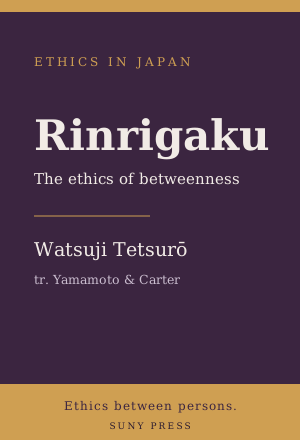
- Title
- Watsuji Tetsurō's Rinrigaku: Ethics in Japan
- Author / Translators
- Watsuji Tetsurō; translated by Seisaku Yamamoto and Robert E. Carter
- Publisher
- State University of New York Press (SUNY series in Modern Japanese Philosophy)
- Length
- ~393 pp. (an abridgement of the three-volume original)
- Difficulty
- Advanced ★★★ — three to five weeks
Check price & availability on the Amazon product page
What it is — in three lines
Rinrigaku is Watsuji's systematic ethics, developed over the 1930s and 1940s. Its guiding claim is that ethics is not the inner morality of an isolated individual but something that arises between people — in relationships, communities, and the whole "betweenness" (aidagara) in which we actually live. This SUNY Press volume, translated by Seisaku Yamamoto and Robert E. Carter, is the standard English edition; it is an abridgement of the three-volume Japanese original, and the review reflects that.
The core — the human being is "betweenness"
Watsuji begins from a fact of language. The Japanese word for a human being, ningen, is written with characters meaning "person" and "between" — and in that doubleness he reads the whole truth about us: we are individuals, and we are the web of relations between individuals, at the same time. Ethics, then, cannot be built from the lone conscience outward; it has to start from the relational whole and understand the individual as one moment of it. He develops this into an account of trust, community, and the "emptying" of the self into and out of social wholes — a genuine alternative to the individualism that modern Western ethics usually takes for granted.
The human being is neither the individual alone nor society alone, but the betweenness in which the two arise together.
— on the central thesis of Watsuji's Rinrigaku
In an age that treats the autonomous individual as self-evident, the argument reads less like a period piece than a live provocation.
Three highlights
1. A real alternative
Few ethical systems start anywhere but the individual. Watsuji's does, and following it stretches your sense of what a moral theory can even be.
2. The reading of ningen
The move from a single word to a whole anthropology is the book's signature — a case study in how a language can carry a philosophy.
3. Carter's apparatus
Robert Carter, a leading interpreter of Watsuji, supplies an introduction and framing that make the abridged text navigable for a first-time reader.
What to watch out for
Two honest notes. First, this is the hard end of the shelf: don't start here. If you have not read Climate and Culture and taken your bearings from Kasulis, the argument will feel airless; with them behind you, it opens. Second, it is an abridgement of a much larger work, and Watsuji's ethics has a fraught relation to the nationalism of its era — the emphasis on the social whole was read by some as underwriting the wartime state. A serious reader should keep that context in view; Carter's introduction addresses it, and it is part of why the book still generates debate.
Check price & availability on the Amazon product page