Home › Top 5 › Climate and Culture
Review: Climate and Culture — the one Watsuji to read first
★★★★★4.8 / 5.0 (editorial rating)
Verdict: if you read one Watsuji, read this one. Human existence is never abstract — it is placed, in a climate and a landscape and a way of life, and the three types of monsoon, desert, and meadow give you his whole way of seeing in one readable book. Concrete, vivid, and the clearest single door into his philosophy. The best place to start.
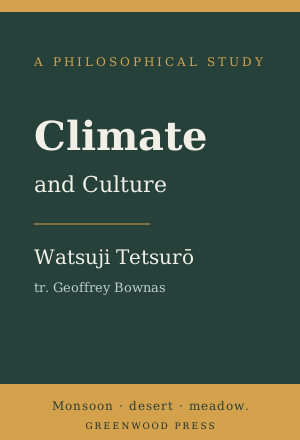
- Title
- Climate and Culture: A Philosophical Study (Fūdo)
- Author / Translator
- Watsuji Tetsurō; translated by Geoffrey Bownas
- Publisher
- Greenwood Press (Documentary Reference Collections)
- Length
- ~235 pp.
- Difficulty
- Intermediate ★★☆ — about seven hours
Check price & availability on the Amazon product page
What it is — in three lines
Written after Watsuji's years of study in Europe (1927–28) and first published in Japanese in 1935, Fūdo is his best-known book: a philosophical study of how human existence is bound up with fūdo — "climate" in the widest sense, land and weather and the whole lived environment. He builds it around three types — the monsoon, the desert, and the meadow — and shows how each shapes the way people feel, endure, work, and think. This is the standard English translation by Geoffrey Bownas.
The core — climate is not the weather outside
The heart of the book is a single reversal. We are tempted to treat climate as an objective fact — so many degrees, so much rainfall — observed by a mind standing outside it. Watsuji argues that this is backwards. We never meet the cold as a measurement; we meet it shivering, huddling, building against it — and all of that is already climatic, already a way of finding ourselves in a place. Where Heidegger's Being and Time had made time the horizon of human existence, Watsuji sets out to restore what he thought it neglected: space, and our climatic, bodily placement in a shared world.
We find ourselves in climate, and in this discovery of ourselves we find ourselves already related to others.
— Watsuji, Climate and Culture (paraphrasing the book's central claim)
From that starting point the three types open out, and the differences between cultures come into view not as a ranking of higher and lower but as different answers to different climates.
Three highlights
1. The three types are clarifying
Monsoon (receptive, enduring), desert (combative, resolute), and meadow (rational, self-directed) give you a framework that instantly organises how you see the cultures of the world — a rare thing in philosophy, a big idea you can actually hold.
2. It answers Heidegger
Read as a reply to Being and Time — supplying the spatiality and the climatic body that Watsuji found missing there — the book gains a real place in the history of twentieth-century thought.
3. The examples do the work
The writing is full of concrete description — houses, storms, ways of farming and worshipping — so the argument never floats free of the world it is about. It is why this, of all his books, is the one to start with.
What to watch out for
Two honest notes. First, the three types are a philosophical model, not geographical determinism. Read as "climate causes character" they invite easy objections; Watsuji himself insists he is not offering a simple environmental determinism, and the generalisations about whole regions are of their 1930s moment — read them as heuristics, not verdicts. Second, this is the masterwork but not the system: the ethics of "betweenness" it gestures toward is worked out elsewhere. When you want that, it is the signal to move on to Rinrigaku.
Check price & availability on the Amazon product page