Home › Top 5 › Pilgrimages to the Ancient Temples in Nara
Review: Pilgrimages to the Ancient Temples in Nara — meet the writer before the philosopher
★★★★☆4.5 / 5.0 (editorial rating)
Verdict: the gentlest possible entry. This is Watsuji at twenty-nine, before the system — a travel diary of a 1918 trip through the ancient temples of Nara, written by someone with an extraordinary eye for sculpture, painting, and old buildings. No technical vocabulary, no argument to follow; just the sensibility that would later drive all his philosophy of culture. Read it first and Watsuji stops being forbidding.
- Title
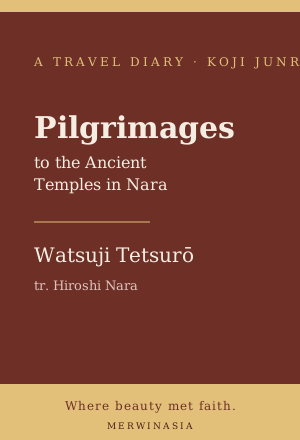
- Pilgrimages to the Ancient Temples in Nara (Koji Junrei)
- Author / Translator
- Watsuji Tetsurō; translated with an introduction by Hiroshi Nara
- Publisher
- MerwinAsia (distributed by University of Hawai‘i Press)
- Length
- ~225 pp. (with colour plates and endnotes)
- Difficulty
- Beginner ★☆☆ — about six hours
Check price & availability on the Amazon product page
What it is — in three lines
Koji Junrei records a trip the young Watsuji took in 1918 to the old capital of Nara, where he spent days among Buddhist temples and their treasures — the sculptures of Chūgūji and Yakushiji, the architecture of Hōryūji, the wall paintings and images that survive from Japan's earliest Buddhist centuries. It became a beloved classic of Japanese travel writing. This is the first full English translation, by Hiroshi Nara, with an introduction, the translator's notes, Watsuji's own later preface, and colour plates of the works he describes.
The core — looking as a way of thinking
The book has no thesis in the philosophical sense. What it has is a method that would become philosophy: Watsuji looks, and lets the looking become thought. Standing before a statue, he moves from the immediate aesthetic shock to questions of history, technique, faith, and cultural exchange — the way a Buddhist image carries traces of Greece and India and China all the way to Nara. The attention that would later produce Climate and Culture and his studies in cultural history is already here, in a younger, more lyrical key.
To stand before these ancient images is to feel, before one understands, how much of the world has passed through them.
— from the spirit of Watsuji's Koji Junrei (editorial paraphrase)
That is why it works so well as a first book: you experience Watsuji's mind doing what it does best, without needing to have read a word of theory.
Three highlights
1. Pure sensibility
Before the philosopher of ethics there was this: a writer of rare feeling for beauty. The prose is warm and immediate, and asks nothing of you but attention.
2. The seed of everything later
Read it and you can see where his lifelong themes — culture, tradition, the way a place holds a history — first took root. It quietly explains the rest of the shelf.
3. A superb edition
Hiroshi Nara's introduction and notes set the trip in context, and the colour plates let you see what Watsuji saw. As an object and as scholarship, it is a generous way to read the book.
What to watch out for
Two honest notes. First, this is not philosophy, and it is not meant to be — if you want the arguments, they are in Climate and Culture and Rinrigaku. Treat this as the doorway, not the room. Second, some of the young Watsuji's art-historical judgements have dated, and the tone is that of an educated Japanese traveller of 1918; the translator's apparatus helps you read it in context rather than as current scholarship.
Check price & availability on the Amazon product page