Home › Top 5 › Spinoza: A Life
Review: Spinoza: A Life — the man behind "God, or Nature"
★★★★★4.7 / 5.0 (editorial rating)
Verdict: the definitive biography, and the book that makes the whole system human. Nadler follows Spinoza from the Amsterdam Jewish community that expelled him at twenty-three, through the years of lens-grinding and quiet writing, to the professorship he turned down to keep his freedom — all set inside the turbulent Dutch Golden Age. The best way to grasp why Spinoza thought as he did, and why it was so dangerous. Now in a second edition.
- Title
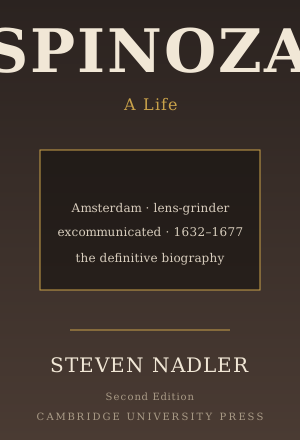
- Spinoza: A Life (2nd edition)
- Author
- Steven Nadler
- Publisher
- Cambridge University Press (2nd ed., 2018)
- Length
- Biography · ~488 pp.
- Difficulty
- Intermediate ★★☆ — long, but narrative and readable
Check price & availability on the Amazon product page
What it is — in three lines
Steven Nadler's Spinoza: A Life — winner of the Koret Jewish Book Award on first publication and now revised into a second edition — is the standard modern biography. It reconstructs Spinoza's life from the surviving evidence: his Portuguese-Jewish family in Amsterdam, the cherem (excommunication) that cut him off from his community at twenty-three, his trade as a grinder of optical lenses, his circle of freethinking friends, and the storm of controversy that met his books. Throughout, Nadler weaves the philosophy into the life, so that ideas and biography illuminate each other.
The core — philosophy inside a life
The great strength of the book is that it refuses to treat Spinoza's thought as if it fell from the sky. Nadler shows why a philosophy of "God, or Nature," of necessity, and of freedom as understanding might have grown out of exactly this life — a man cast out of one community for his ideas, living modestly and independently in the most tolerant and turbulent society in seventeenth-century Europe. The famous cherem, the anonymous publication of the Theological-Political Treatise and the scandal it caused, the decision to decline a chair at Heidelberg rather than compromise his freedom of thought: each episode is set beside the ideas it shadows. You come away understanding not just what Spinoza argued but why it mattered so much, and to whom.
Three highlights
1. The cherem, reconstructed with care
The expulsion is the most famous event of Spinoza's life and the most mythologised. Nadler weighs the evidence soberly — what we know, what we don't, and what it likely meant — and the result is more gripping than the legend.
2. The Dutch Golden Age as living context
Spinoza's tolerationist politics make sense against the real backdrop of the Dutch Republic — its printers, its religious tensions, its brief openness and sudden violence. Nadler paints that world so the ideas sit inside it.
3. Life and thought, kept in conversation
This is a biography that takes the philosophy seriously without turning into a textbook. It is the ideal companion volume to the primary texts on this shelf.
What to watch out for
Two honest notes. First, it is long — nearly 500 pages — and it is a biography, not an exposition of the arguments: for a step-by-step account of the Ethics as philosophy you still want the Very Short Introduction or the primary texts themselves, and Nadler has written a separate book (Spinoza's Ethics: An Introduction) if you want his own guide to the argument. Second, the historical record on Spinoza is genuinely thin in places; Nadler is scrupulous about marking where he is reconstructing and where the evidence gives out, and you should read those careful hedges as a strength, not a gap. Bibliographic note: specifics here assume the Cambridge University Press second edition (2018).
Check price & availability on the Amazon product page