Home › Top 5 › A Very Short Introduction
Review: Spinoza: A Very Short Introduction — the map before the climb
★★★★★4.6 / 5.0 (editorial rating)
Verdict: the best place to start. In about 140 pages Roger Scruton lays out Spinoza's entire system — "God, or Nature," the single substance, and the idea that freedom is understanding rather than free will — so that when you finally open the Ethics its proofs have somewhere to land. Opinionated and dense for its length, but exactly the map this shelf is built around.
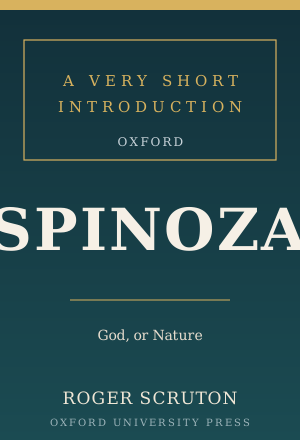
- Title
- Spinoza: A Very Short Introduction
- Author
- Roger Scruton
- Publisher
- Oxford University Press (Very Short Introductions)
- Length
- Introduction · ~144 pp.
- Difficulty
- Beginner ★☆☆ — short, but not simplistic
Check price & availability on the Amazon product page
What it is — in three lines
This is a short, single-author introduction to the whole of Spinoza — the metaphysics, the theory of mind and emotion, the politics, and the religion — written by the philosopher Roger Scruton for Oxford's Very Short Introductions series. It does not walk through the Ethics proposition by proposition; instead it reconstructs the system as a connected argument and explains why Spinoza built it the way he did. In about 140 pages it gives you the frame the primary texts assume you already have.
The core — "God, or Nature"
Everything in Spinoza turns on a single, startling identification: "God, or Nature" (Deus sive Natura). God is not a person issuing commands from outside the world; God is the world — the one infinite substance of which everything that exists, including you and your thoughts and feelings, is a "mode." Scruton is very good at showing why this is not a pious dodge but a radical monism, and at drawing out its consequence: if all things follow from the nature of that one substance by necessity, then there is no free will in the ordinary sense. Yet — and this is the turn the whole shelf depends on — that is not a counsel of despair. Freedom, for Spinoza, is the movement from being passively driven by emotions we don't understand to actively living from an adequate understanding of our own nature. Get that one idea straight here, and the Ethics stops being a wall.
Three highlights
1. The system as a single argument
Rather than paraphrasing the geometrical proofs, Scruton reassembles them into a line of reasoning you can hold in your head. It is the difference between a floor plan and a pile of bricks.
2. A philosopher arguing, not just reporting
Scruton has his own views and presses them — he pushes on where he thinks Spinoza succeeds and where the monism strains. That makes the book more alive than a neutral summary, and it models how to read Spinoza critically rather than reverently.
3. The right length
A hundred and forty pages is short enough to finish in a weekend and long enough to carry the real architecture. It respects your time without dumbing the subject down.
What to watch out for
Two honest notes. First, "short" does not mean "easy." Scruton writes densely and assumes you will think as you read; some paragraphs on substance, attribute, and mode repay a second pass. That is a feature — this is a real philosophical introduction, not a listicle — but do not expect to skim it. Second, it is one philosopher's Spinoza. Scruton's conservative sympathies colour his emphases, and other readers foreground the political and democratic Spinoza more than he does. Treat it as an argued map, not the last word — and let the Theological-Political Treatise and Nadler's Life widen the picture.
Check price & availability on the Amazon product page