Home › Top 5 › Theological-Political Treatise
Review: Theological-Political Treatise — why the state should protect freedom of thought
★★★★★4.6 / 5.0 (editorial rating)
Verdict: the other masterwork — the one Spinoza dared to publish (anonymously) while he lived. It reads Scripture as a historical document rather than the literal word of God, and separates the province of faith from that of reason, then argues that freedom of thought and speech is exactly what keeps a state stable and at peace. It is a headwater of modern toleration and free expression. Jonathan Israel's Cambridge edition surrounds the text with a scholar's introduction and notes.
- Title
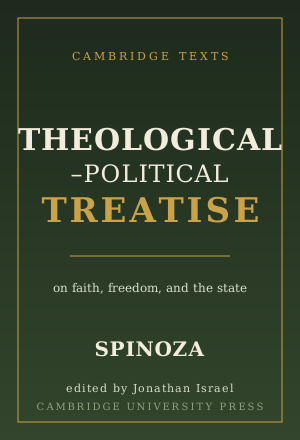
- Theological-Political Treatise (Cambridge Texts in the History of Philosophy)
- Author
- Benedict de Spinoza
- Editor / Translator
- Jonathan Israel (ed.); tr. Michael Silverthorne & Jonathan Israel
- Publisher
- Cambridge University Press (original: 1670)
- Length
- Primary source · ~329 pp.
- Difficulty
- Advanced ★★★ — a primary text, but easier to follow than the Ethics
Check price & availability on the Amazon product page
What it is — in three lines
The Theological-Political Treatise (1670) is the work Spinoza wrote alongside the Ethics and published anonymously in his lifetime — and it caused a scandal that followed him for the rest of it. The first half develops a historical-critical reading of the Bible: not a book that speaks truth directly as the word of God, but a text to be understood in light of the age, language, and circumstances in which it was written. The second half turns from there to the state and to liberty, arguing that recognising freedom of thought and speech is indispensable to a state's peace and stability. Jonathan Israel's edition adds an authoritative introduction and notes.
The core — dividing faith from reason
The book's aim is to draw a firm line between the province of faith (theology) and the province of philosophy (reason). What Scripture teaches, on Spinoza's reading, is not advanced metaphysical truth but a plain lesson of obedience and practice — revere God and love your neighbour. So Scripture must not be used to bind philosophical inquiry or science, and faith need not be justified by argument: the two have different ends. From this separation a decisive conclusion follows. What a person thinks in their own mind, and what they say, is something the state can never fully control anyway. Better, then, to permit it freely than to try to crush it — the state is in fact more stable that way. The courage of writing this in an age of religious persecution and political repression reaches us undimmed four centuries later.
Three highlights
1. The shock of "reading Scripture historically"
To examine a sacred text together with the situation in which it was written. What is now the commonplace of biblical scholarship has one of its bold starting points here, and Spinoza's habit of reading a text from within is at its clearest.
2. A classic prototype of the argument for free expression
The claim that freedom of thought and speech stabilises a society becomes a core of later liberalism. You can trace the deep source of modern debates over free expression to these pages.
3. Prose you can actually follow
Unlike the geometrical Ethics, this is continuous argument, and it is far easier to follow proposition to point. It is an excellent place to taste Spinoza's "actual writing," and Israel's edition keeps the historical context within reach.
What to watch out for
Two points. First, the biblical sections move through specific passages of the Hebrew Bible, so if you are unused to Scripture you can stall on proper names and references. The trick is not to get snagged on the details but to follow the thread — how should Scripture be read? Second, this is the entrance to Spinoza's political thought, whose theoretical skeleton lies in the monism of the Ethics. Read alongside it — and alongside Nadler's Life, which explains just how dangerous this book was to publish — and the whole of Spinoza's social thought comes into view. Bibliographic note: specifics of pagination and phrasing here assume the Cambridge Texts edition edited by Jonathan Israel.
Check price & availability on the Amazon product page