Review: Ethics — why write about God and freedom as geometry?
★★★★★5.0 / 5.0 (editorial rating)
Verdict: Spinoza's masterwork and one of the summits of Western philosophy. What God is, how mind and body relate, and why we are tossed about by our emotions — all built up like a geometry textbook, from definitions and axioms to propositions and proofs. The formal apparatus is the hardest thing on this shelf, but with Edwin Curley's authoritative translation and a little preparation, you touch Spinoza's own frame of mind directly. The goal of the shelf.
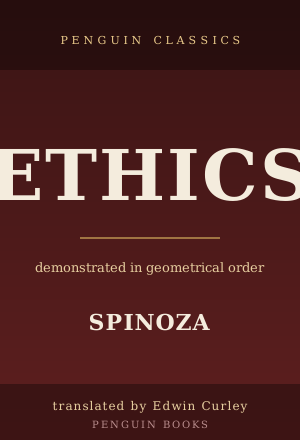
- Title
- Ethics (Penguin Classics)
- Author
- Benedict de Spinoza
- Translator
- Edwin Curley (introduction by Stuart Hampshire)
- Publisher
- Penguin Classics (original: 1677, posthumous)
- Length
- Primary source · ~384 pp.
- Difficulty
- Advanced ★★★ — the shelf's hardest climb (geometrical proof)
Check price & availability on the Amazon product page
What it is — in three lines
The Ethics is the book Spinoza worked on for most of his life and never published while he lived; it appeared only after his death in 1677. Its full title is Ethics, Demonstrated in Geometrical Order, and it means it: following Euclid, Spinoza sets down definitions and axioms and then proves propositions from them, one after another, across five parts — on God, on the mind, on the emotions, on human bondage, and on human freedom. In a single deductive system it treats God, mind, feeling, and liberty as one connected whole. Edwin Curley's is the standard English translation.
The core — "God, or Nature" as the starting point
Underneath everything sits the famous thesis of "God, or Nature" (Deus sive Natura). For Spinoza God is not a person commanding the world from outside; God is the world — nature itself. There exists exactly one substance (God-or-Nature), and each of us, and our thoughts and emotions too, exist as "modes" of that one infinite nature, held within necessity. From this monism free will, in the ordinary sense, is denied. But this is not despair. The geometry of the emotions worked out in Parts III–IV points to a path: from the unfreedom of being swept along by passive emotions to the freedom of living actively, from an adequate understanding of things. Running God, mind, and emotion through one and the same order of necessity — that relentlessness is what has kept the book alive for nearly four centuries.
Three highlights
1. The strange ambition of "proving" ethics
To take the most volatile things — feelings, ways of living — and argue them through with the necessity of geometry. The form itself is Spinoza's claim, and reading through the form you feel his worldview from the inside.
2. An analysis of the emotions that still reads as modern
Starting from joy, sadness, and desire, Part III dissects how envy, hope, and fear arise as if taking apart a machine. Read beside today's psychology of emotion it has not dated; it becomes a tool for watching your own mind from the outside.
3. Curley's authoritative translation
Edwin Curley's rendering — the basis of the standard scholarly Collected Works — is the reliable English footing for reading Spinoza, careful with the technical vocabulary that carries the whole argument.
What to watch out for
Two points. First, this is the hardest climb on the shelf. Try to follow every demonstration completely from the first page and you will usually run out of breath somewhere in Part I. We strongly recommend reading for the claim of each proposition first — get the shape of the whole — and going back afterwards only for the proofs that grip you. Second, do not make this your first Spinoza. Open it after you have the core of "freedom" from the Very Short Introduction and, ideally, some of the man and context from Nadler's Life; the same proofs become startlingly more readable once the map is in place. One honest bibliographic note: the specifics of pagination and phrasing here assume the Penguin Classics edition in Curley's translation.
Check price & availability on the Amazon product page