Home › Top 5 › A Spinoza Reader
Review: A Spinoza Reader — the whole thinker in one volume
★★★★☆4.4 / 5.0 (editorial rating)
Verdict: the whole thinker in miniature. Edwin Curley — translator of the standard scholarly edition — gathers the complete Ethics alongside the early works, key letters, and treatise selections, with a lucid introduction, in a single well-guided book. If you want Spinoza's corpus in one volume rather than several separate editions, this is the pick, and it doubles as a companion to the Penguin Ethics — same translator, same hand.
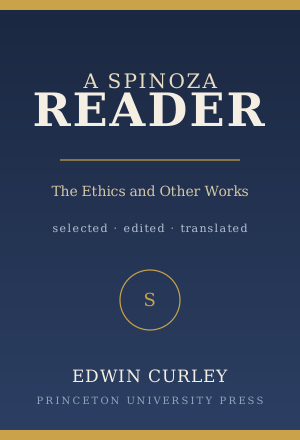
- Title
- A Spinoza Reader: The Ethics and Other Works
- Author
- Benedict de Spinoza
- Editor / Translator
- Edwin Curley
- Publisher
- Princeton University Press
- Length
- Anthology · ~361 pp.
- Difficulty
- Intermediate ★★☆ — a guided selection of primary texts
Check price & availability on the Amazon product page
What it is — in three lines
Edited and translated by Edwin Curley — the scholar behind the standard Collected Works of Spinoza — this Princeton volume is a one-stop anthology. It prints the Ethics in full and sets around it the Treatise on the Emendation of the Intellect, parts of the early Short Treatise, selections from the two political treatises, and a run of Spinoza's most important letters, all under a clear editorial introduction. In one book you get the shape of Spinoza's whole development, in the same translator's voice throughout.
The core — the corpus, guided by its translator
The value of the Reader is that it is curated and translated by one authoritative hand. Reading the Ethics in isolation, you can miss how Spinoza arrived at it; here the early Treatise on the Emendation of the Intellect shows the young philosopher working out his method, the letters show him defending and clarifying his ideas to real correspondents, and the political selections point forward to the Theological-Political Treatise. Curley's introduction and connective notes make the pieces speak to one another, so the volume reads not as a scrapbook but as a single, guided passage through the system — with "God, or Nature" and the geometry of the emotions at its centre.
Three highlights
1. The Ethics plus its context, in one hand
You get the masterwork whole, and the early works and letters that surround it — the same translation, so the technical vocabulary stays consistent from piece to piece.
2. The letters
Spinoza's correspondence is where the abstract system meets objections and pressure. Reading him answer real questions is one of the fastest ways to see what the propositions actually commit him to.
3. A trustworthy editor
Curley's selection and introduction are a scholar's map of the corpus. For a reader who wants breadth without buying five separate volumes, that guidance is the whole point.
What to watch out for
Two honest notes. First, it is a selection, not the complete works: the political treatises appear in excerpt, not in full, so if your main interest is the politics you will still want the standalone Theological-Political Treatise. Second, because it contains the complete Ethics, it overlaps with our #2, the Penguin Ethics — the two are the same translator, so you would not normally buy both. Think of the Reader as the choice when you want the Ethics and the surrounding works together, and the Penguin as the choice when you want the Ethics alone in a slim, low-cost volume. Bibliographic note: specifics here assume the Princeton edition edited by Edwin Curley.
Check price & availability on the Amazon product page