SAICHŌ BOOK GUIDE
The 5 Best Saichō & Tendai Books in English (2026)
— a reading order that won't defeat you
Saichō (767–822), known by the title Dengyō Daishi, sailed to Tang China, brought back the Tiantai teaching, founded the great monastery on Mount Hiei, argued with the young Kūkai and with the Nara scholar-monk Tokuitsu, and spent his last years fighting to win an independent Mahāyāna ordination platform. It is a life you can follow as a single story. But here is the honest catch for English readers: almost none of Saichō's own writings have been translated into English. So this shelf does the next best thing — it maps the finest English books around him: a cultural history to place him, the standard scholarly study of his achievement, the scripture he built everything on, and the tradition he founded. Five books, ranked, in an order that actually works.
The editorial room behind this site runs a family of thinker bookshelves and a section-by-section reading archive of primary texts. This is a historical and scholarly guide, not the promotion of any sect: every recommendation is a currently-purchasable title from an established academic press (Hawai'i, Columbia), and every page is honest about the one hard fact — that we approach Saichō, for now, mostly through others.
Our RankingRANKING
The editorial order. If you can't decide, start at #1. Check prices and availability on the Amazon product pages.
-
1
 If in doubt, start hereBeginner
Japanese Buddhism: A Cultural History
Before you meet Saichō, see the landscape he changed. Tamura's readable survey runs the whole fourteen-century sweep of Japanese Buddhism, and its chapter on the Heian period puts Saichō and Kūkai exactly where they belong — as the two founders who broke Buddhism free of Nara. The gentlest possible on-ramp, and the book that makes every title below make sense.
Check price & availability on Amazon
View on Amazon Read our review -
2
 Advanced
Saichō: The Establishment of the Japanese Tendai School
The single indispensable book. Groner's study is the standard English-language account of Saichō — his life, his journey to China, and above all his long, costly campaign to found an independent Tendai ordination on Mount Hiei using the Mahāyāna bodhisattva precepts. It is a scholarly monograph, not a light read, but nothing else in English comes close as the definitive treatment.
Check price & availability on Amazon
View on Amazon Read our review -
3
 Intermediate
The Lotus Sutra
You cannot understand Saichō without the scripture at the centre of his school. The Lotus Sutra is Tendai's heart-text — the source of its claim that every being, without exception, can become a buddha. Watson's celebrated translation reads with real narrative drive, full of the sutra's famous parables. Read the text Saichō staked his life's work on, in the most accessible English version.
Check price & availability on Amazon
View on Amazon Read our review -
4
 Advanced
Ryōgen and Mount Hiei: Japanese Tendai in the Tenth Century
What became of Saichō's mountain? Groner's second great study follows Mount Hiei a century and a half on, when the reformer Ryōgen turned Saichō's fragile community into the most powerful monastic institution in Japan. Read it to see the seed become the tree — how the ordination platform Saichō barely won reshaped the whole of later Japanese Buddhism.
Check price & availability on Amazon
View on Amazon Read our review -
5
 Advanced
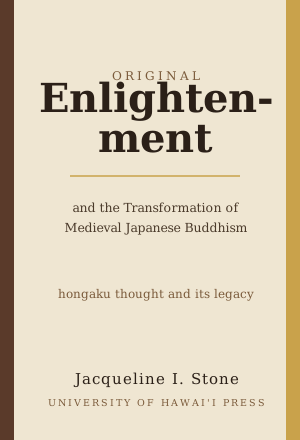
Original Enlightenment and the Transformation of Medieval Japanese Buddhism
The furthest ring outward. Stone's award-winning study traces hongaku ("original enlightenment") thought — the radical idea, nurtured on Mount Hiei, that enlightenment is not a goal but the true status of all things — and shows how it flowed from Tendai into the whole of medieval Japanese Buddhism, shaping Zen, Pure Land and Nichiren alike. The best single book on what Saichō's tradition became.
Check price & availability on Amazon
View on Amazon Read our review
The 5 Books at a GlanceCOMPARE
The biggest worry with a subject like this is "can I actually read this?" Choose by difficulty and type — one gentle survey, one scripture, three scholarly studies.
| Title | Difficulty | Length | Type | Best for | Links |
|---|---|---|---|---|---|
| Japanese Buddhism: A Cultural HistoryTamura · Kosei Publishing | Beginner ★☆☆ | ~232 pp. ~6 hrs |
Survey / history | Placing Saichō in the whole sweep before you dive in | View on Amazon Review |
| Saichō: The Establishment of the Japanese Tendai SchoolGroner · Hawai'i / Kuroda | Advanced ★★★ | ~350 pp. 2–3 weeks |
Scholarly study | The definitive account of Saichō himself | View on Amazon Review |
| The Lotus Sutratr. Watson · Columbia UP | Intermediate ★★☆ | ~352 pp. ~10 hrs |
Primary scripture | Reading the text Tendai is built on | View on Amazon Review |
| Ryōgen and Mount HieiGroner · Hawai'i | Advanced ★★★ | ~525 pp. 3–4 weeks |
Institutional history | What Saichō's mountain became after him | View on Amazon Review |
| Original Enlightenment...Stone · Hawai'i / Kuroda | Advanced ★★★ | ~566 pp. 3–4 weeks |
Doctrinal history | How Tendai thought reshaped all medieval Japanese Buddhism | View on Amazon Review |
A Reading Order That Won't Defeat YouROADMAP
The two ways people stall on Saichō in English are starting with a 500-page scholarly monograph cold and trying to memorise terms (the three-vehicle/one-vehicle debate, the bodhisattva precepts, hongaku) as dictionary entries. Instead: place him, read his scripture, then his life, then his legacy. Climb in four steps.
-
STEP 1 ── Get your bearings (one book)
Read Tamura's Japanese Buddhism: A Cultural History
Do not begin with Saichō in close-up. Begin with the map. Tamura's survey shows you where the Heian founders sit in fourteen centuries of Japanese Buddhism, so that "Tendai," "Mount Hiei" and "Nara Buddhism" become places you can locate rather than words to look up. A weekend's reading that saves you weeks of confusion.
A Cultural History on Amazon -
STEP 2 ── Read the scripture at the centre
Read The Lotus Sutra in Watson's translation
Everything Saichō built rests on one text and its promise that all beings can become buddhas. Read it now, while it is the foreground and not a footnote. Watson's version moves like a story; you do not need to catch every doctrinal point, only to feel why this sutra could organise a whole school of Buddhism.
The Lotus Sutra on Amazon -
STEP 3 ── The man himself (the core)
Take on Groner's Saichō
Now you are ready for the definitive study. With the landscape and the scripture in hand, Groner's detailed account of Saichō's life and his battle for an independent Mahāyāna ordination reads not as a wall of terms but as the drama it is. This is the summit of understanding Saichō himself.
Groner's Saichō on Amazon -
STEP 4 ── The legacy (the goal)
See what he founded — Ryōgen and Mount Hiei and Original Enlightenment
Saichō's importance is really the importance of what grew from him. Groner's Ryōgen shows Mount Hiei becoming the powerhouse of Japanese Buddhism; Stone's Original Enlightenment shows Tendai thought reshaping Zen, Pure Land and Nichiren. Reach this step and the shelf has done its job: Saichō stops being a name and becomes the source of a river.
Ryōgen on AmazonOriginal Enlightenment review
How We ChoseCRITERIA
Four criteria. First, currently in print and actually available on amazon.com — every title has a live product page from an established academic publisher (University of Hawai'i Press with the Kuroda Institute, Columbia University Press, Kosei Publishing). Second, and most important to state plainly: Saichō's own writings — the Sange gakushōshiki, the Kenkairon and the rest — have essentially never been translated into English. So unlike a shelf on a Western philosopher, this one cannot put a primary text by its subject at #1. Instead we build outward from him: a cultural history to place him (Tamura), the definitive modern study of his life (Groner), the scripture his school is founded on (the Lotus Sutra), and the tradition that grew from him (Groner's Ryōgen, Stone's Original Enlightenment). We say so on every relevant page rather than pretend otherwise. Third, the ladder must hold: survey → scripture → the man → the legacy, each step preparing the next. Fourth, a neutral, scholarly tone: this is a historical and academic guide to a major figure in Japanese religious history, not the promotion of a sect, and the reviews keep to what the books actually argue. The editorial room's judgements rest on first-hand reading and explicit bibliographic checking.
Still Undecided? Take This OneCONCLUSION
If you have read this far and still can't choose, the answer is simple: start with Tamura's Japanese Buddhism: A Cultural History. It is the one genuinely beginner-friendly book here, and it gives you the frame everything else fits into — after it, Saichō and Tendai stop being isolated names. If you already know the outline of Japanese Buddhism and want the heart of the subject, go straight to Groner's Saichō, the definitive study; that is this shelf's recommended route to the man himself.
Check price & availability on the Amazon product pages