Home › Top 5 › Original Enlightenment
Review: Original Enlightenment and the Transformation of Medieval Japanese Buddhism
★★★★★4.5 / 5.0 (editorial rating)
Verdict: the furthest ring outward from Saichō, and a landmark of the field. The idea nurtured on his mountain — that all things are already enlightened as they are — went on to reshape Zen, Pure Land and Nichiren alike. Stone's award-winning study is the best single book on what Saichō's tradition ultimately became.
- Title
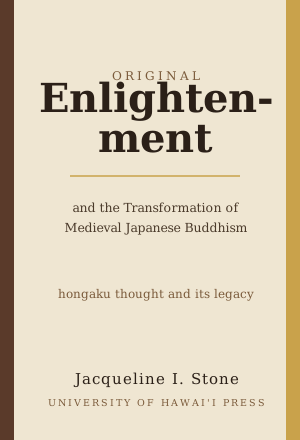
- Original Enlightenment and the Transformation of Medieval Japanese Buddhism
- Author
- Jacqueline I. Stone
- Publisher
- University of Hawai'i Press / Kuroda Institute (1999; paperback 2003)
- Length
- Scholarly monograph · ~566 pp. (3–4 weeks)
- Difficulty
- Advanced ★★★ — the most conceptually demanding book here
Check price & availability on the Amazon product page
What it is — in three lines
Jacqueline I. Stone is a leading scholar of Japanese Buddhism, long at Princeton. This book — which won the American Academy of Religion's Award for Excellence — is the major study of hongaku ("original enlightenment") thought, the current of ideas that dominated medieval Tendai and radiated from Mount Hiei into the whole of Japanese Buddhism. It works closely with the secret oral-transmission (kuden) literature in which that thought was carried.
Why it is the last step
Original enlightenment thought makes a startling claim: enlightenment is neither a goal to be reached nor a potential to be developed, but the true status of all things exactly as they are. Grass and trees, this very body, the ordinary deluded mind — all are already, in their nature, awakened. Nurtured in medieval Tendai, this idea became the shared background of the age, and Stone shows how it fed into the new movements of Kamakura Buddhism — the Zen of Dōgen, the Pure Land of Hōnen and Shinran, the Lotus devotion of Nichiren. It is the deepest current running from Saichō's mountain, which is why this shelf ends here: from the founder, to his school, to the tree, to the idea that outgrew them all.
Stone is also refreshingly critical. She engages the modern "hongaku criticism" debate — the charge by some Japanese scholars that original-enlightenment thought drains Buddhism of its ethical and practical urgency — and weighs it soberly rather than either endorsing or dismissing the tradition. That even-handedness is exactly the neutral, scholarly footing this shelf aims for.
Three highlights
1. A difficult idea, made precise
"Everything is already enlightened" is easy to say and easy to misunderstand. Stone gives it rigour, history and texture, so you grasp what medieval Tendai actually meant — and did not mean — by it.
2. The bridge to Kamakura Buddhism
The book is the best English demonstration that the famous "new" schools grew out of the old Tendai soil rather than in reaction against it from outside. It reframes the whole story of medieval Japanese religion.
3. The kuden literature
Stone opens up the strange, secret transmission texts in which this thought was passed down — a body of material almost invisible in English before her work.
What to watch out for
Two honest notes. First, this is the most conceptually demanding book on the shelf, and it is long: it belongs last, after Tamura, the Lotus and Groner have built your footing. Do not start here. Second, and importantly, it is about the tradition centuries after Saichō, not about Saichō — hongaku thought developed in the medieval Tendai that grew from him, not in his own writings. Read it to understand the ultimate reach of what he founded, and the shelf's arc is complete.
Check price & availability on the Amazon product page