Home › Top 5 › Japanese Buddhism: A Cultural History
Review: Japanese Buddhism: A Cultural History — the map before Saichō
★★★★☆4.3 / 5.0 (editorial rating)
Verdict: the beginner's book of this shelf, and the one nobody should skip. Before you meet Saichō in close-up, you need to know where he stands — and Tamura's single readable volume gives you fourteen centuries of Japanese Buddhism at a glance, with the Heian founders exactly in place. Start here and the harder books stop being walls.
- Title
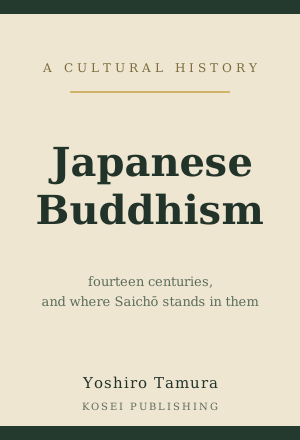
- Japanese Buddhism: A Cultural History
- Author
- Yoshiro Tamura, tr. Jeffrey Hunter
- Publisher
- Kosei Publishing (English ed. 2000)
- Length
- Survey · ~232 pp. (~6 hrs)
- Difficulty
- Beginner ★☆☆ — written for the general reader
Check price & availability on the Amazon product page
What it is — in three lines
Yoshiro Tamura (1921–1989) was one of the leading modern scholars of Japanese Buddhism, a specialist in Tendai and Nichiren thought at the University of Tokyo. This book, translated by Jeffrey Hunter, is his one-volume cultural history: the whole arc of Buddhism in Japan, from its arrival in the sixth century through the Nara and Heian schools, the Kamakura reformers and on to the modern age. It was written to be read straight through by non-specialists, and it is.
Why it belongs first
Most English readers meet Saichō already lost — dropped into "the Tendai–Hossō debate" or "the Mahāyāna precept platform" with no sense of the country these terms belong to. Tamura fixes that in a weekend. His Heian chapters set Saichō and Kūkai side by side as the two monks who broke Japanese Buddhism free of the Nara establishment, one founding Tendai on Mount Hiei, the other Shingon on Mount Kōya. Once you can see that shape, every specialist study on this shelf snaps into focus.
The book's other quiet strength is its author. Tamura was himself a major scholar of Tendai hongaku (original enlightenment) thought — the very current that Jacqueline Stone's book (also on this shelf) treats in depth. So even his brisk survey is written by someone who knew the deep water, and it never talks down.
Three highlights
1. The Heian turn, told clearly
The chapters on Saichō and Kūkai are the reason this book leads our shelf: they give you the founders' rivalry, their journeys to Tang China, and the stakes of establishing new schools — as narrative, not jargon.
2. The whole river, not one bend
Because it runs to the modern period, you see where Saichō's tradition goes — how Mount Hiei became the seedbed from which Hōnen, Shinran, Dōgen and Nichiren all emerged. It quietly previews the last two books on this shelf.
3. A cultural, not sectarian, lens
Tamura writes as a historian of culture, attentive to art, society and politics as much as doctrine. That neutral, contextual tone is exactly what a newcomer needs before taking sides on anything.
What to watch out for
Two honest notes. First, this is a survey: Saichō gets a chapter, not a book. It is the frame, not the portrait — for the portrait you go to Groner. Second, a single-volume history of fourteen centuries necessarily compresses; specialists will find debates flattened. That is the right trade for a first book, but do not mistake breadth for the last word. Note also that other fine one-volume histories exist (for example the Wiley-Blackwell Cultural History of Japanese Buddhism by Deal and Ruppert); Tamura earns its place here by being the most readable on-ramp.
Check price & availability on the Amazon product page