Home › Top 5 › The Lotus Sutra
Review: The Lotus Sutra (tr. Burton Watson) — the scripture at the heart of Tendai
★★★★★4.6 / 5.0 (editorial rating)
Verdict: the one primary text this shelf can hand you directly. You cannot understand Saichō without the sutra he built everything on — and Watson's translation makes the Lotus, for all its cosmic scale, genuinely readable. Not by Saichō, but the closest thing to reading over his shoulder.
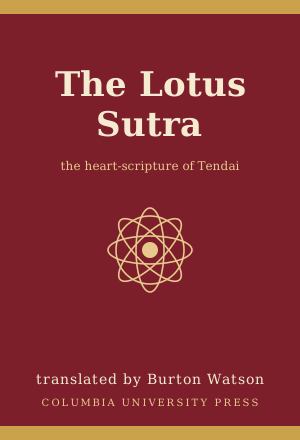
- Title
- The Lotus Sutra
- Translator
- Burton Watson (from Kumārajīva's Chinese)
- Publisher
- Columbia University Press (1993)
- Length
- Primary scripture · ~352 pp. (~10 hrs)
- Difficulty
- Intermediate ★★☆ — readable, but a scripture, not a story
Check price & availability on the Amazon product page
What it is — in three lines
The Lotus Sutra (Saddharma Puṇḍarīka) is one of the most revered scriptures of Mahāyāna Buddhism, treasured across East Asia since it reached China in the third century. The version Japan inherited is Kumārajīva's early-fifth-century Chinese translation, and that is what Burton Watson — one of the great translators of Chinese and Japanese — renders here for Columbia University Press. It is the text on which the Tiantai/Tendai school is founded.
Why Saichō built on this text
Tendai takes its stand on one claim of this sutra above all: the "One Vehicle" (ekayāna) — that the many apparent paths of Buddhism are ultimately one, and that every living being, without exception, is destined for buddhahood. That teaching of universal awakening is the whole ground of Saichō's project, and the exact point on which he fought the Nara scholar Tokuitsu. Read the sutra and Saichō's life stops being a set of institutional quarrels and becomes what it was to him: the defence of a promise made to everyone.
The sutra makes its case not by argument but by parable, and this is its gift to a modern reader. The burning house whose children are lured out with the promise of toy carts; the poor man who does not know a jewel has been sewn into his robe; the physician's feigned death to shock his sons into taking the cure — these are among the most influential stories in Asian religious literature, and Watson tells them with clarity and momentum.
Three highlights
1. The parables
The burning house, the prodigal son, the phantom city, the jewel in the robe — image after image that later Buddhist culture, art and poetry return to endlessly. This is where they live.
2. The promise of universal buddhahood
The dragon king's daughter — female, a child, and non-human — attains buddhahood on the spot, a startling dramatisation of the sutra's claim that awakening is open to all. This is the beating heart of Tendai.
3. Watson's readability
Scripture can be forbidding; Watson's English is plain, dignified and swift. It is widely regarded as the most approachable complete translation, which is why we place it here rather than a more technical scholarly edition.
What to watch out for
Two honest notes. First, this is a sacred text, not a treatise or a narrative: it is repetitive by design, moves between prose and verse restatements, and unfolds on a cosmic scale with vast assemblies and immense spans of time. Read it for its images and its central promise, not for a plot. Second, it is the Indian-and-Chinese scripture, not a Japanese or Tendai commentary — it shows you what Saichō revered, while the specialist books on this shelf show you what his school made of it. Other respected translations exist (Reeves, Kubo & Yuyama, Kern's older version); Watson earns its place by being the most readable.
Check price & availability on the Amazon product page