Home › Top 5 › Saichō (Groner)
Review: Saichō: The Establishment of the Japanese Tendai School — the definitive study
★★★★★4.7 / 5.0 (editorial rating)
Verdict: the one indispensable book on Saichō in English. If you read a single scholarly study of the man, it is this one — Groner's account of a monk's decades-long, ultimately posthumous fight to give his school its own ordination. Demanding, but the definitive treatment, with no real rival.
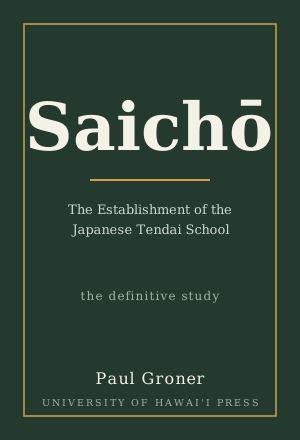
- Title
- Saichō: The Establishment of the Japanese Tendai School
- Author
- Paul Groner
- Publisher
- University of Hawai'i Press / Kuroda Institute (this ed. 2000, with new preface; orig. 1984)
- Length
- Scholarly monograph · ~350 pp. (2–3 weeks)
- Difficulty
- Advanced ★★★ — an academic study, best read third
Check price & availability on the Amazon product page
What it is — in three lines
Paul Groner is one of the foremost Western scholars of Japanese Buddhism. This book, first published in 1984 and reissued by the University of Hawai'i Press with the Kuroda Institute (with a new preface), is the standard English-language study of Saichō. It follows his life — his early retreat on Mount Hiei, his voyage to Tang China to gather the Tiantai teachings, his fraught relations with Kūkai — and centres on the achievement that defined him: the founding of an independent Tendai order.
Why it is the definitive study
Saichō's great struggle was over ordination. In his day, every Japanese monk was legally ordained under the older Hīnayāna (vinaya) precepts controlled by the Nara establishment. Saichō argued that his Tendai monks should instead take the Mahāyāna bodhisattva precepts and be ordained on Mount Hiei itself — a bid for institutional independence that Nara fiercely resisted. The court granted it only days after his death in 822. Groner reconstructs this campaign in patient detail, and in doing so explains why Saichō matters: he did not just import a doctrine, he built the self-standing institution from which most later Japanese Buddhism would spring.
What makes the book definitive is its command of the sources. Groner works from Saichō's own writings and the surrounding documents — precisely the materials that remain untranslated for the general English reader — and lays out the debates with a fairness that has kept the study standard for forty years.
Three highlights
1. The precept campaign, in full
The heart of the book. You come away understanding not just that Saichō wanted a Mahāyāna ordination platform but why it was revolutionary — and how much it cost him.
2. Saichō and Kūkai, from the record
Their early friendship and later estrangement — including Kūkai's refusal to lend a key esoteric text and the departure of Saichō's disciple Taihan — are handled soberly, from the documents, without the novelistic embroidery such stories usually attract.
3. The debate with Tokuitsu
Groner sets out the great controversy with the Hossō scholar-monk Tokuitsu over the "one vehicle" — whether all beings, without exception, can attain buddhahood — which is Saichō's deepest doctrinal commitment and the Lotus Sutra's central claim.
What to watch out for
One honest warning: this is an academic monograph, and it reads like one. It assumes you already have the lay of the land — which is exactly why our shelf puts Tamura's history and the Lotus Sutra before it. Come to Groner cold and the precept technicalities can feel airless; come to it third, and the same pages read as the drama they are. It is a study of Saichō's establishment of the school, not a full cradle-to-grave biography, and it is scholarship, not narrative — judged as scholarship, it is superb.
Check price & availability on the Amazon product page