MARX BOOK GUIDE
The 5 Best Karl Marx Books (2026)
— from the Manifesto to Capital, in reading order
Almost everyone who sets out to "read Marx" reaches for Capital, opens the first chapter on the commodity and the value-form, and quietly closes it again. That is the wrong door. Marx wrote in German and left a vast body of work, but there is a staircase up to it. Start with a short map of the whole system, read the Manifesto in an afternoon, meet the young Marx of the 1844 manuscripts, and only then climb Capital. Five real English editions from established publishers — Oxford, Penguin and Norton — arranged not by fame but by readability and reading order.
The editorial room behind this site runs a family of philosopher bookshelves and a section-by-section reading archive of the primary texts. This page is neutral by design: it presents the works and how to read them, and takes no political side for or against Marx — the aim is to hand you the tools to read him for yourself.
Our RankingRANKING
The editorial order. If you can't decide, start at #1. Check prices and availability on the Amazon product pages.
-
1
 If in doubt, start hereBeginner
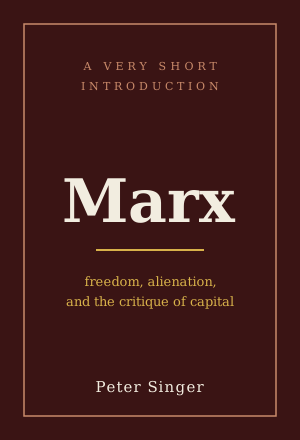
Marx: A Very Short Introduction
The single best entry point. In about 150 pages Peter Singer lays out the whole system — alienation, historical materialism, the economic argument of Capital, and Marx's idea of communism — in plain English, treating Marx above all as a philosopher of human freedom. Read this and every later book falls into place.
Check price & availability on Amazon / Kindle edition available
View on Amazon Read on Kindle Read our review -
2
 Beginner
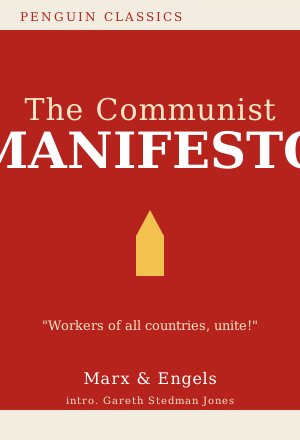
The Communist Manifesto (Penguin Classics)
The most famous short book of the nineteenth century, and the accessible primary text: forty pages of Marx and Engels' own prose, sweeping from the history of class conflict to a programme for revolution. This Penguin Classics edition adds Gareth Stedman Jones's book-length introduction placing the pamphlet in its 1848 context — so you can read the source and then the scholarship.
Check price & availability on Amazon
View on Amazon Read our review -
3
 Intermediate
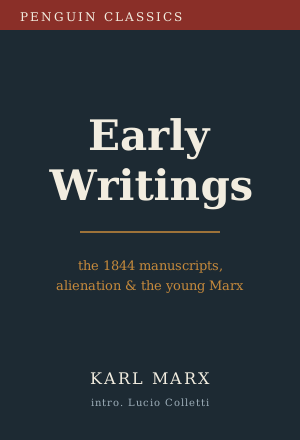
Early Writings (Penguin Classics)
Where the philosophy lives. This volume collects the young Marx — above all the Economic and Philosophic Manuscripts of 1844, with their account of alienated labour, alongside "On the Jewish Question" and the critique of Hegel. If Capital is the economics, these are the humanist roots underneath it, and the reason so many readers care about Marx at all.
Check price & availability on Amazon
View on Amazon Read our review -
4
 Intermediate
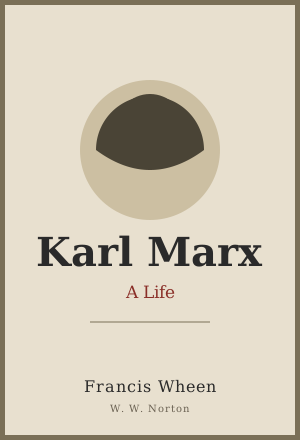
Karl Marx: A Life
The ideas make more sense once you know the man. Francis Wheen's award-winning biography is witty, humane and scrupulous — the exiled journalist forever chased by creditors, the devoted and difficult family man, the reader who spent decades in the British Museum writing Capital. The best single book for turning "Marxism" back into a person in a particular century.
Check price & availability on Amazon / Kindle edition available
View on Amazon Read on Kindle Read our review -
5
 Advanced
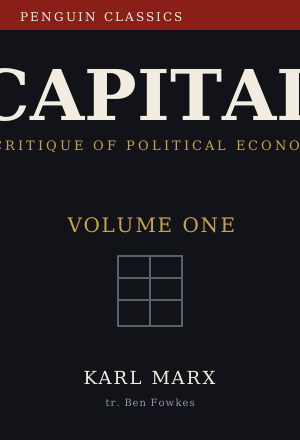
Capital, Volume 1 (Penguin Classics)
The magnum opus, given its standard scholarly edition. Ben Fowkes's translation is the one most cited in English, and Mandel's introduction and the full apparatus turn the analysis of the commodity, value, and surplus-value into a text you can actually work through. Long and demanding — but after the four steps below, its difficulty becomes a climb rather than a wall.
Check price & availability on Amazon / Kindle edition available
View on Amazon Read on Kindle Read our review
The 5 Books at a GlanceCOMPARE
The biggest worry with Marx is "can I actually get through this?" Choose by difficulty and length — a short introduction and a biography sit at one end, Capital at the other.
| Title | Difficulty | Length | Type | Best for | Links |
|---|---|---|---|---|---|
| Marx: A Very Short IntroductionPeter Singer · Oxford | Beginner ★☆☆ | ~152 pp. ~3 hrs |
Scholarly introduction | First contact; you want the whole system in one sitting | View on Amazon Review |
| The Communist ManifestoMarx & Engels · Penguin Classics | Beginner ★☆☆ | ~304 pp. text ~2 hrs |
Primary source + intro | You want Marx's own voice, fast | View on Amazon Review |
| Early WritingsKarl Marx · Penguin Classics | Intermediate ★★☆ | ~460 pp. ~1 week |
Primary source (young Marx) | You want alienation and the humanist roots | View on Amazon Review |
| Karl Marx: A LifeFrancis Wheen · W. W. Norton | Intermediate ★★☆ | ~448 pp. ~1 week |
Biography | You want the man behind the ideas | View on Amazon Review |
| Capital, Volume 1tr. Ben Fowkes · Penguin Classics | Advanced ★★★ | ~1,152 pp. weeks–months |
Primary source (magnum opus) | You want the argument itself, in full | View on Amazon Review |
A Reading Order That Won't Defeat YouROADMAP
Most people fail at Marx for one reason: they start with the first chapter of Capital, where the argument is at its most abstract. Get the shape of the whole system first, meet Marx's own voice and the young philosopher underneath the economics, and the summit stops being sheer. Climb in three steps.
-
STEP 1 ── Get the map, then the voice (books 1–2)
Read Singer's Very Short Introduction, then the Communist Manifesto
Singer draws the whole system in 150 pages — alienation, historical materialism, the core of the economic argument. Then read the Manifesto itself: forty pages of Marx and Engels' own prose, so that the source is no longer a rumour but something you have read. Map first, then voice.
Very Short Introduction on AmazonThe Manifesto on Amazon -
STEP 2 ── The young philosopher and the man (books 3–4)
Read the Early Writings for the ideas, Wheen's Life for the man
The Early Writings — chiefly the 1844 manuscripts on alienated labour — are where Marx the philosopher of freedom is clearest, and where the why behind Capital comes from. Wheen's biography sets all of it inside a life: the exile, the poverty, the decades in the British Museum. Read them together and the summit stops being abstract.
Early Writings on AmazonKarl Marx: A Life on Amazon -
STEP 3 ── The summit (the goal)
Take on Capital, Volume 1
Now the magnum opus, in Fowkes's standard translation. You already have the map, the voice, and the humanist roots, so the opening chapters on the commodity and value read as the hard first pitch of a climb, not a locked gate. Work through it slowly, section by section; Mandel's introduction and the notes carry you over the steepest stretches.
View on AmazonRead our review
How We ChoseCRITERIA
Three criteria. First, currently in print and actually available on amazon.com — every title has a live product page from an established publisher (Oxford University Press, Penguin Classics, W. W. Norton), in a reliable translation where translation applies. Second, the ladder must hold: short introduction → Marx's own short text → the young philosopher and the man → the full magnum opus, each step preparing the next, with an entry point at every height. Third, neutrality and honesty about what each book is: this site presents Marx's work and takes no side for or against it. A short introduction is a map, a biography is one author's portrait, and a primary text is Marx's own argument — the reviews say which is which. This English edition is not a translation of our Japanese shelf; it maps the same roles (introduction, accessible primary, concepts, study, magnum opus) onto the best-established English editions.
Still Undecided? Take This OneCONCLUSION
If you have read this far and still can't choose, the answer is simple: start with Marx: A Very Short Introduction. In a single short book Singer gives you the whole shape of Marx's thought, so that whatever you read next has somewhere to go. Get the map here, spend an afternoon with the Communist Manifesto, and the road up to Capital is open.
Check price & availability on the Amazon product pages