Home › Top 5 › Capital, Volume 1
Review: Capital, Volume 1 — the summit, and how to climb it
★★★★★4.8 / 5.0 (editorial rating)
Verdict: the magnum opus, and the reason this shelf exists. Ben Fowkes's translation is the standard English text, and Mandel's introduction and the full apparatus make Marx's analysis of the commodity, value and surplus-value navigable. Long and demanding — but taken after the four earlier steps, its difficulty is a climb, not a locked gate.
- Title
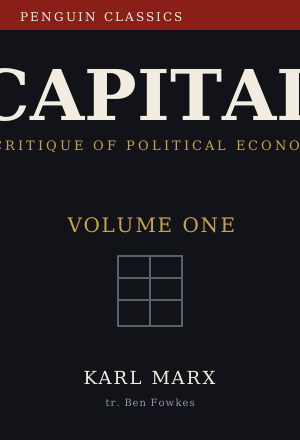
- Capital: A Critique of Political Economy, Volume 1 (Penguin Classics)
- Author
- Karl Marx, tr. Ben Fowkes; introduction by Ernest Mandel
- Publisher
- Penguin Classics (original: 1867)
- Length
- Primary source · ~1,152 pp. · weeks to months
- Difficulty
- Advanced ★★★ — the hardest, and the point of it all
Check price & availability on the Amazon product page
What it is — in three lines
Volume 1 is the only part of Capital Marx finished and published in his lifetime (1867); volumes 2 and 3 were assembled by Engels from his notes. It builds from the smallest unit of capitalist society — the commodity — through value, money, and the extraction of surplus-value, to the working day, machinery, and finally "the so-called primitive accumulation" that set the whole system going. This Penguin Classics edition uses Ben Fowkes's 1976 translation with Ernest Mandel's long introduction. The book the other four on this shelf have been preparing you to read.
Why it is the summit
The famous difficulty is almost entirely in the opening chapters. Marx begins with the most abstract material — the two-fold character of the commodity, the value-form, commodity fetishism — precisely where a first-time reader has the least footing, which is why starting Capital cold is the classic way to abandon it. But the notorious first hundred pages sit on top of ideas you have already met: the alienation of the Early Writings, the map from Singer. Push through Part I and the book opens out into some of the most vivid social writing of the nineteenth century.
A commodity appears at first sight an extremely obvious, trivial thing. But its analysis brings out that it is a very strange thing, abounding in metaphysical subtleties and theological niceties.
— Marx, Capital, Vol. 1, ch. 1 (Fowkes translation)
From the chapter on the working day onward — with its documentary detail of factory life — the prose becomes gripping, and the analytical machinery built in Part I starts paying off. Reaching that turn is the goal the whole roadmap is built toward.
Three highlights
1. Commodity fetishism
The closing section of chapter 1 — how relations between people come to look like relations between things — is one of the most influential passages in modern thought, and repays slow reading.
2. "The Working Day"
Part of the book's moral core: Marx's use of factory-inspector reports turns theory into an indictment of concrete conditions, and it reads faster than anything before it.
3. Fowkes and Mandel
The Fowkes translation is the scholarly standard, and Mandel's introduction plus the appendices (including "The Results of the Immediate Process of Production") make this the edition to own rather than a bare public-domain reprint.
What to watch out for
Three honest notes. First, do not start here — everything on this shelf is arranged so that you don't. Second, consider reading with a guide: David Harvey's A Companion to Marx's Capital is a well-known chapter-by-chapter aid, and many readers tackle Part I twice. Third, and most important for this site: Capital is a work of analysis and critique that has been read in radically different ways, and we present it as a text to be understood and argued with, not a programme to be endorsed or condemned. Read it, then make up your own mind.
Check price & availability on the Amazon product page