Home › Top 5 › The Communist Manifesto
Review: The Communist Manifesto — Marx and Engels in their own voice
★★★★★4.5 / 5.0 (editorial rating)
Verdict: the accessible primary text, and one every reader should meet at first hand. Forty pages of Marx and Engels' own prose carry you from "the history of all hitherto existing society is the history of class struggles" to a call for revolution. This Penguin Classics edition frames it with a book-length introduction, so the source comes with its context attached.
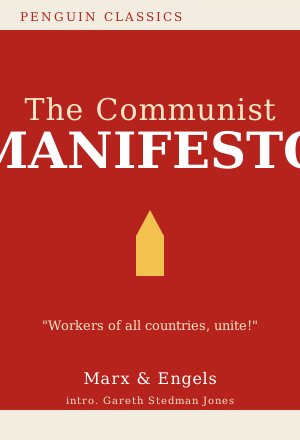
- Title
- The Communist Manifesto (Penguin Classics)
- Author
- Karl Marx & Friedrich Engels; introduction by Gareth Stedman Jones
- Publisher
- Penguin Classics (original: 1848)
- Length
- ~304 pp. total · the Manifesto itself ~40 pp.
- Difficulty
- Beginner ★☆☆ — the text reads in an afternoon
Check price & availability on the Amazon product page
What it is — in three lines
Written by Marx and Engels for the Communist League and published on the eve of the 1848 revolutions, the Manifesto is a short political pamphlet in four parts: the history of class conflict, the position of the communists, a critique of rival socialisms, and a closing programme. This Penguin Classics volume prints that brief, electric text alongside Gareth Stedman Jones's substantial historical introduction. The most quoted short book of modern politics, with its scholarship attached.
Why read it at first hand
So much is said about the Manifesto that people forget how short and how readable it is. Reading it directly, you discover that it is not a dry programme but a piece of rhetoric with real velocity — the famous opening about a "spectre haunting Europe," the sweeping account of what the bourgeoisie has done to the world, the sudden turns of phrase. You also discover that some of its most cited lines are more qualified, or more strange, than their reputation suggests.
The history of all hitherto existing society is the history of class struggles.
— Marx & Engels, The Communist Manifesto, Part I (Moore translation)
Because the core text is only about forty pages, this is the rare primary source you can read in a sitting and then reread with the introduction beside you — exactly the "source, then scholarship" sequence that makes a difficult author approachable.
Three highlights
1. The portrait of capitalism itself
Part I contains a famous, almost admiring description of how the bourgeoisie revolutionises production and dissolves old certainties — "all that is solid melts into air." It is one of the sharpest short accounts of modern economic life ever written, whatever you conclude from it.
2. Stedman Jones's introduction
The book-length essay places the pamphlet precisely in 1848 — who wrote it, for whom, and against which rivals — and is itself a small education in nineteenth-century history. It is why we chose this edition over the many cheaper reprints.
3. A document you can weigh for yourself
Read directly, the Manifesto becomes evidence rather than slogan: predictions that came true, predictions that did not, and rhetoric you can assess on its own terms. That is the honest use of a primary source.
What to watch out for
Two notes. First, the Manifesto is a political call to action, not a worked-out theory: the economics that justifies it is barely present here and lives instead in Capital. Read the pamphlet for Marx's voice and vision, not for the argument's foundations. Second, this site takes no side on that call — we present the document and its context so you can judge it, and note that the Penguin introduction is itself one scholar's reading, not the last word.
Check price & availability on the Amazon product page