Home › Top 5 › Karl Marx: A Life
Review: Karl Marx — A Life — the man behind the ideas
★★★★★4.5 / 5.0 (editorial rating)
Verdict: the ideas make more sense once you know the man. Francis Wheen's biography is witty, humane and scrupulously researched — Marx the exiled journalist chased by creditors, the difficult and devoted father, the reader who spent decades in the British Museum. The best single book for turning "Marxism" back into a person in a particular century.
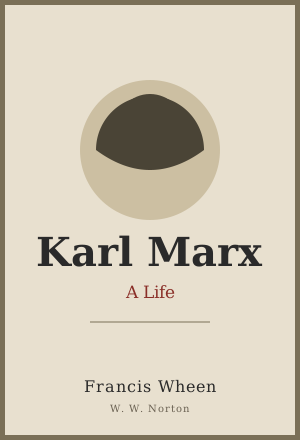
- Title
- Karl Marx: A Life
- Author
- Francis Wheen
- Publisher
- W. W. Norton (first published 1999)
- Length
- ~448 pp. · a week of evenings
- Difficulty
- Intermediate ★★☆ — a narrative, not a treatise
Check price & availability on the Amazon product page
What it is — in three lines
Francis Wheen — a British journalist, not an academic — set out to rescue Marx from both his worshippers and his enemies and write the life of the human being: born in Trier in 1818, exiled through Paris and Brussels to London, poor for most of his adult life, sustained by Engels, grieving the deaths of children, and labouring for decades over the book that became Capital. Widely praised on publication and often named the best readable single-volume life. A biography that reads like a novel and rests on real scholarship.
Why the biography belongs on the ladder
Abstractions become easier to hold once they are attached to a person. Wheen shows you the conditions in which the theories were written — the overcrowded Soho flat, the pawned coats, the pseudonymous journalism Marx wrote to survive, the endless unfinished manuscripts. Knowing that Capital was assembled over twenty years by a chronically ill, chronically broke exile does not change its arguments, but it changes how you read them: as the work of a man, not the scripture of a movement.
Placed after the Early Writings, the life also connects the young philosopher of alienation to the older analyst of capital, so that the two halves of the reading list become one story. It is the humanising step just before the summit.
Three highlights
1. Comedy and humanity
Wheen is genuinely funny and never cruel. The Marx who emerges is exasperating, warm, boil-ridden and brilliant — a full human being rather than a bronze bust, which is exactly what makes the book so readable.
2. The friendship with Engels
The decades-long partnership — intellectual, financial, personal — is drawn with real care, and it explains how the work got finished at all.
3. Balanced, not partisan
Wheen admires his subject but does not spare him: the feuds, the failures, the domestic wrongs are all here. It models the neutral, humane distance this shelf aims for.
What to watch out for
Two notes. First, a biography is one author's portrait: Wheen is sympathetic, and a reader wanting a colder or more critical account might prefer a scholarly life such as Gareth Stedman Jones's Karl Marx: Greatness and Illusion. Second, this is a life, not an exposition of the theory — Wheen sketches the ideas but does not analyse Capital in depth, so treat the book as context for the primary texts, not a replacement for them. As ever, this site offers the portrait without endorsing or condemning its subject.
Check price & availability on the Amazon product page