JOHN LOCKE BOOK GUIDE
The 5 Best John Locke Books (2026)
— from a short introduction to the Two Treatises, in reading order
The philosopher who argued that government rests on the consent of the governed, that we own what we mix our labour with, and that the state has no business over the soul — John Locke stands at the source of liberal politics, and his words echo in the American Declaration of Independence. Yet reach first for the Two Treatises of Government or the vast Essay concerning Human Understanding, and the sheer scale can turn you straight back. Locke has a staircase you can actually climb. A short introduction, then the Two Treatises, then the Letter Concerning Toleration, then the Essay. Five books, in an order that works.
The editorial room behind this site runs a family of philosopher bookshelves — for example The Philosophy Bookshelf and Socrates — and a section-by-section reading archive of the primary texts (in Japanese). Every recommendation rests on first-hand reading, and every page here is honest about one fact: Locke wrote two magnum opuses, and you do not have to storm both at once.
Our RankingRANKING
The editorial order. If you can't decide, start at #1. Check prices and availability on the Amazon product pages.
-
1
 If in doubt, start hereBeginner
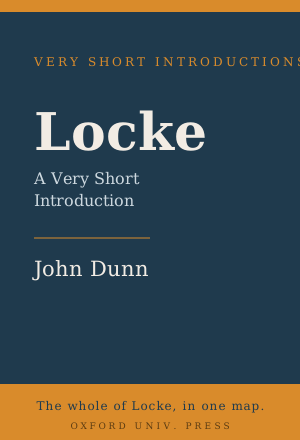
Locke: A Very Short Introduction
The best entry point: a short, authoritative map of Locke's whole project — knowledge and experience, natural rights, property, consent, and toleration — by John Dunn, one of the world's leading Locke scholars. It sets Locke in his turbulent century (the Civil War, exile, the Glorious Revolution) so you meet the man and the ideas at once.
Check price & availability on Amazon / Kindle edition available
View on Amazon Read on Kindle Read our review -
2
 IntermediateThe one Locke to read first
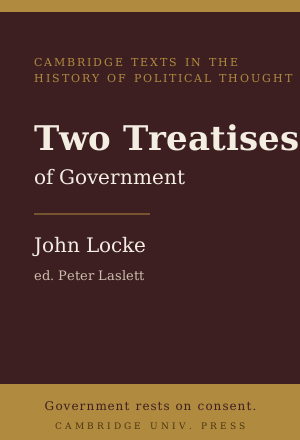
Two Treatises of Government
If you read only one Locke in his own words, read this. The First Treatise demolishes the divine right of kings; the far more famous Second Treatise builds the positive case — the state of nature, natural rights to life, liberty and property, government by consent, and the right of resistance. Peter Laslett's landmark Cambridge edition is the scholarly standard.
Check price & availability on Amazon / Kindle edition available
View on Amazon Read on Kindle Read our review -
3
 Intermediate
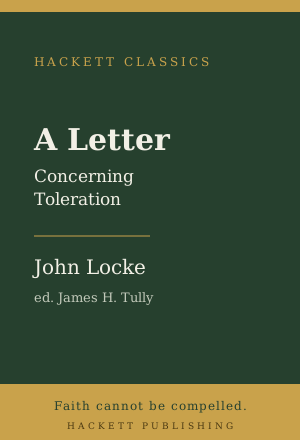
A Letter Concerning Toleration
Locke's short, blazing case for religious toleration. The magistrate's charge, he argues, is our worldly goods — life, liberty, property — not the salvation of the soul; and faith compelled by force is no faith at all. So the state must not impose a creed, and churches must tolerate one another. A founding text of the separation of church and state, in Tully's compact Hackett edition.
Check price & availability on Amazon
View on Amazon Read our review -
4
 Advanced
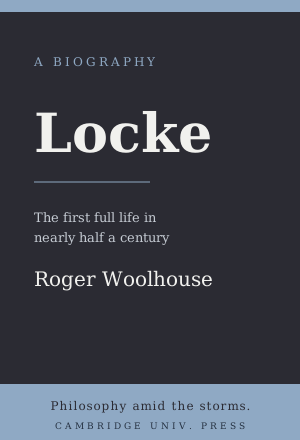
Locke: A Biography
The standard modern life: the first full-scale biography of Locke in nearly half a century. Woolhouse follows the whole career — physician, exile, adviser, and philosopher — and sets the Two Treatises, the Letter, and the Essay in the history that produced them: religious persecution, the exclusion crisis, and the Glorious Revolution. The book to reach for when the ideas make you curious about the man and his century.
Check price & availability on Amazon
View on Amazon Read our review -
5
 Advanced
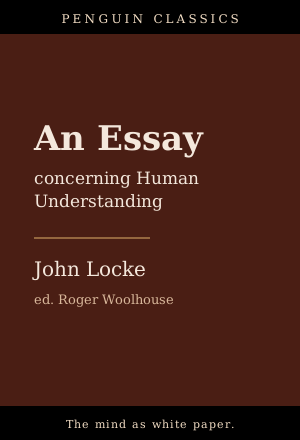
An Essay concerning Human Understanding
Locke's other magnum opus — the founding text of British empiricism. There are no innate ideas, he argues; the mind begins as "white paper," and all our knowledge is built from experience and reflection. Long and demanding, but once the politics has shown you how Locke thinks, this is where his whole account of the mind opens out. Woolhouse's Penguin edition is a well-judged reading text.
Check price & availability on Amazon / Kindle edition available
View on Amazon Read on Kindle Read our review
The 5 Books at a GlanceCOMPARE
The biggest worry with Locke is "can I get through a political classic?" Choose by difficulty and by type — introduction, primary text, biography, study.
| Title | Difficulty | Length | Type | Best for | Links |
|---|---|---|---|---|---|
| Locke: A Very Short IntroductionJohn Dunn · OUP | Beginner ★☆☆ | ~176 pp. ~3 hrs |
Introduction | First contact; the whole map in one sitting | View on Amazon Review |
| Two Treatises of Governmented. Laslett · Cambridge Texts | Intermediate ★★☆ | ~540 pp. 2–3 weeks |
Primary (magnum opus) | Reading one Locke in his own words | View on Amazon Review |
| A Letter Concerning Tolerationed. Tully · Hackett | Intermediate ★★☆ | ~72 pp. ~2 hrs |
Primary (short companion) | The classic of religious liberty | View on Amazon Review |
| Locke: A BiographyRoger Woolhouse · Cambridge | Advanced ★★★ | ~528 pp. a project |
Biography | The man, the works, the century | View on Amazon Review |
| An Essay concerning Human Understandinged. Woolhouse · Penguin Classics | Advanced ★★★ | ~800 pp. 4–6 weeks |
Primary (empiricism) | Locke's theory of the mind, in full | View on Amazon Review |
A Reading Order That Won't Defeat YouROADMAP
People bounce off Locke for two reasons: trying to read a whole magnum opus cover to cover on the first attempt, and trying to memorise "natural rights," "property," and "the right of resistance" before meeting the arguments that give them life. Introduction → the political magnum opus → the short companion → the theory of mind. Climb in four steps.
-
STEP 1 ── Get the map (one book)
Read Dunn's Very Short Introduction
Don't dive into a primary text yet. Dunn lays out the whole of Locke — knowledge, natural rights, property, consent, toleration — in a few hours, and sets him in the century that shaped him. The point is to dissolve the caricature of Locke as "just the founder of liberalism" before you open him.
Dunn's Introduction on Amazon -
STEP 2 ── Read one Locke, in his words (the core)
The Two Treatises of Government
Now the primary text — and the right one to start with. Head straight for the Second Treatise: the state of nature, natural rights, the labour theory of property, government by consent, and the right of resistance, in Locke's own words. Laslett's Cambridge edition carries the apparatus you want. Finish this and you have read the Locke who changed the modern world.
The Two Treatises on AmazonRead on Kindle -
STEP 3 ── The other pillar (short)
The Letter Concerning Toleration — and meet the man in Woolhouse
After the ground of political authority, read its limit. The Letter separates state from church and argues that belief cannot be coerced — the other pillar of Locke's liberalism, in a couple of hours. Read it with Woolhouse's Biography beside you if you want the life and the century that produced these arguments.
The Letter on AmazonWoolhouse's Biography on Amazon -
STEP 4 ── The theory of mind (the goal)
The Essay concerning Human Understanding
Finish with Locke's other magnum opus, the founding text of empiricism: no innate ideas, the mind as "white paper," all knowledge built from experience. Reach it after the politics and you see the single thinker behind both — which is where this shelf was always heading. Long, but the deepest room in the house.
The Essay on AmazonRead our review
How We ChoseCRITERIA
Three criteria. First, currently in print and actually available on amazon.com — every title has a live product page from an established publisher (Oxford, Cambridge, Hackett, Penguin). Second, the ladder must hold: introduction → the political magnum opus → the short companion on toleration → the theory of mind, each step preparing the next, with an entry point at every height from a three-hour primer to an 800-page classic. Third, honesty about what each book is: the Two Treatises is the accessible, world-changing primary text and the best door in; the Essay is the denser second magnum opus, kept for last on purpose; the biography is scholarship, not a light life. The reviews say so. The editorial room runs a family of philosopher bookshelves and a section-by-section archive of the primary texts (in Japanese); those first-hand readings are the foundation here.
Still Undecided? Take This OneCONCLUSION
If you have read this far and still can't choose: start with Dunn's Very Short Introduction, then read the Two Treatises of Government. The introduction gives you the whole map of Locke — knowledge, rights, property, consent, toleration — in an afternoon, and the Two Treatises is the one primary text to read if you read only one. That two-book route is this shelf's recommendation; everything else builds from there.
Check price & availability on the Amazon product pages