Home › Top 5 › Two Treatises of Government
Review: Two Treatises of Government — the one Locke to read first
★★★★★4.7 / 5.0 (editorial rating)
Verdict: if you read one Locke in his own words, read this one. The First Treatise demolishes the divine right of kings; the far more famous Second Treatise builds the positive case — the state of nature, natural rights, the labour theory of property, government by consent, and the right of resistance. Peter Laslett's landmark Cambridge edition is the scholarly standard, and the best door into the originals.
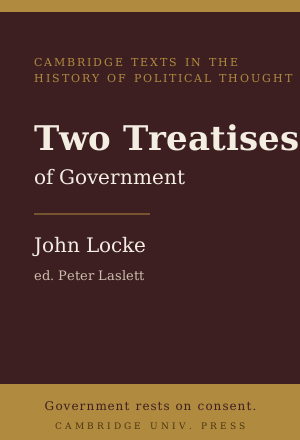
- Title
- Two Treatises of Government
- Author / Editor
- John Locke; edited with an introduction by Peter Laslett
- Publisher
- Cambridge University Press (Cambridge Texts in the History of Political Thought)
- Length
- ~540 pp. (text with introduction and apparatus)
- Difficulty
- Intermediate ★★☆ — two to three weeks
Check price & availability on the Amazon product page
What it is — in three lines
Published anonymously in 1689, the Two Treatises is Locke's foundational work of political philosophy. The First Treatise is a point-by-point refutation of Robert Filmer's defence of absolute, God-given monarchy; the Second Treatise — the one everyone reads — sets out a positive theory of legitimate government. This Cambridge edition, edited by Peter Laslett, is the scholarly landmark: it established the work's real date and gives you the authoritative text with a major introduction.
The core — rights, property, and consent
Locke begins where no king rules: a state of nature governed by a law of nature that binds everyone equally, in which each person has natural rights to life, liberty, and possessions. Property arises when we mix our labour with the world — the famous labour theory. Because the state of nature has real inconveniences, people consent to form a government whose sole purpose is to protect those rights. And because its power is a trust, a government that turns against the people forfeits it: the right of resistance.
The great and chief end, therefore, of men's uniting into commonwealths, and putting themselves under government, is the preservation of their property.
— Locke, Second Treatise, §124
These are the arguments that echo through the eighteenth century and into the American Declaration of Independence. Reading them in the original, you feel how radical they were.
Three highlights
1. Start with the Second Treatise
You can read the Second Treatise on its own, and most readers should: it is the self-contained, world-changing half. The First is a period demolition of Filmer that you can come back to later.
2. Laslett's apparatus
Laslett's edition is a monument of scholarship — it redated the work to the exclusion crisis and reads Locke as a revolutionary, not a complacent apologist for 1688. The introduction and notes do a great deal of the historical work for you.
3. The labour theory of property
Chapter V, "Of Property," is one of the most argued-over passages in political thought, the seed of centuries of debate about ownership, labour, and justice. Reading it in context is worth the price of admission.
What to watch out for
Two honest notes. First, it is a seventeenth-century text with real difficulties: the scriptural argument of the First Treatise and Locke's tensions on property and slavery repay slow, critical reading. If you have not yet, spend a few hours with Dunn's introduction first — the Treatises go faster with the map in hand. Second, this is Locke's politics; his theory of knowledge is a separate magnum opus, the Essay concerning Human Understanding. This book is one pillar of Locke, not the whole.
Check price & availability on the Amazon product page