Home › Top 5 › Locke: A Very Short Introduction
Review: Locke: A Very Short Introduction — the best place to start
★★★★★4.6 / 5.0 (editorial rating)
Verdict: the ideal first book. Before you open a single primary text, John Dunn — a scholar who has spent a career on Locke — hands you the whole map: knowledge and experience, natural rights, property, consent, and toleration, set inside the violent century that shaped them. A few hours here make every later page easier.
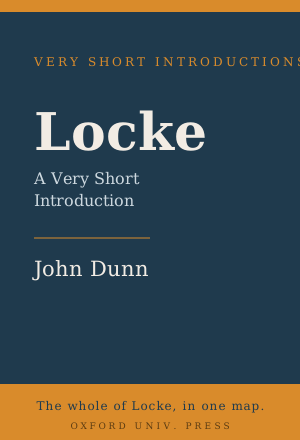
- Title
- Locke: A Very Short Introduction
- Author
- John Dunn
- Publisher
- Oxford University Press (Very Short Introductions)
- Length
- ~176 pp.
- Difficulty
- Beginner ★☆☆ — about three hours
Check price & availability on the Amazon product page
What it is — in three lines
This is a compact, authoritative overview of Locke's life and thought in Oxford's Very Short Introductions series, written by John Dunn, whose scholarship reshaped how the twentieth century read Locke's politics. In under two hundred pages it covers the theory of knowledge, the account of natural rights and property, government by consent, and religious toleration — and places all of it in Locke's turbulent age. The single best on-ramp before the primary texts.
The core — one thinker behind politics and knowledge
Dunn's central move is to refuse the caricature. Locke is not merely "the founder of liberalism," a bundle of slogans about rights and property; he is a religious thinker for whom our duties to God, our knowledge of the world, and our political obligations form one connected view. Dunn shows how the empiricism of the Essay and the politics of the Two Treatises belong to the same mind, and how much of what later ages took from Locke they took by simplifying him.
Locke matters, today as much as ever, because he thought hard about how human beings can know anything at all, and about how they ought to live together.
— in the spirit of Dunn's Locke
What makes the book valuable rather than merely tidy is that Dunn is honest about the tensions in Locke — on slavery, on property, on the reach of consent — instead of smoothing them away.
Three highlights
1. Written by a leading authority
Dunn is not a populariser passing through; his earlier work is part of the scholarship that changed the field. You are getting the considered view of someone who knows the texts and the debates from the inside.
2. The whole of Locke, in one map
Politics, epistemology, religion, and toleration are treated together, so you leave with a sense of how the parts connect — exactly what you need before you meet any one of them at length.
3. Locke in his century
The book keeps the history in view — exile, the exclusion crisis, the Glorious Revolution — so the ideas read as responses to a dangerous world, not as timeless abstractions.
What to watch out for
Two honest notes. First, it is an interpretation, not a neutral summary: Dunn has a considered reading of Locke, and while he is fair to the alternatives, a beginner should take this as one authoritative view rather than the last word. Second, it is a map, not the territory: it will not substitute for reading Locke himself. Use it to orient, then go to the Two Treatises for the real thing. Read in that order, the introduction pays for itself many times over.
Check price & availability on the Amazon product page