Home › Top 5 › An Essay concerning Human Understanding
Review: An Essay concerning Human Understanding — Locke's theory of mind
★★★★★4.5 / 5.0 (editorial rating)
Verdict: Locke's other magnum opus, and the founding text of British empiricism. There are no innate ideas, he argues; the mind begins as "white paper," and all our knowledge is built from experience and reflection. Long and demanding — which is why we keep it for last — but once the politics has shown you how Locke thinks, this is the deepest room in the house. Woolhouse's Penguin edition is a well-judged reading text.
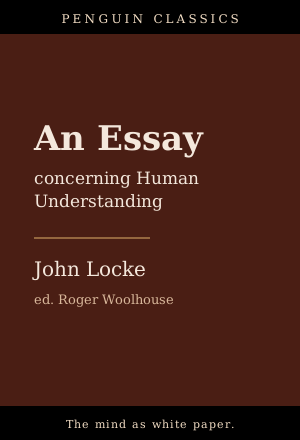
- Title
- An Essay concerning Human Understanding
- Author / Editor
- John Locke; edited with an introduction by Roger Woolhouse
- Publisher
- Penguin Books (Penguin Classics)
- Length
- ~800 pp.
- Difficulty
- Advanced ★★★ — four to six weeks
Check price & availability on the Amazon product page
What it is — in three lines
First published in 1689, the Essay is Locke's account of what the human mind can know and how. It opens by attacking the doctrine of innate ideas and argues instead that the mind is at birth "white paper, void of all characters," furnished only later by experience — sensation and reflection. This Penguin Classics edition, edited by Roger Woolhouse, gives you a well-judged reading text of a very long work, with an introduction that orients a first-time reader.
The core — no innate ideas, the mind as white paper
Locke's programme is to map the origin, extent, and limits of human knowledge. All our materials, he argues, come from experience: simple ideas enter through the senses and through the mind's reflection on its own operations, and the understanding then combines them into the complex ideas we think with. From this he develops famous distinctions — primary and secondary qualities, the workmanship of the understanding, the puzzle of personal identity — and a sober conclusion about how much is genuinely within our reach.
Let us then suppose the mind to be, as we say, white paper, void of all characters, without any ideas. How comes it to be furnished? … To this I answer, in one word, from experience.
— Locke, Essay, II.i.2
This is the book that set the agenda for British empiricism and, through Berkeley and Hume, for a century of philosophy after it.
Three highlights
1. The foundation of empiricism
Almost every later debate about perception, knowledge, and the mind starts here. Reading the Essay is reading the source, not a commentary on it.
2. The famous set-pieces
Primary and secondary qualities, the "molyneux problem," and the memory-based account of personal identity are landmarks of philosophy — and they are vivid and argued, not dry.
3. Woolhouse's reading edition
The Essay is enormous; Woolhouse's Penguin text and introduction make a sane starting point for a first encounter without demanding the full scholarly apparatus at once.
What to watch out for
Two honest notes. First, it is long and uneven: at some 800 pages, Locke repeats himself and digresses, and few first readers go straight through every chapter. Use the introduction to pick a path — Books II and IV are the heart. Second, read it after the politics, not before: coming to the Essay once Dunn and the Two Treatises have shown you how Locke argues makes the theory of mind far less forbidding. This is the deep end, kept for last on purpose.
Check price & availability on the Amazon product page