Home › Top 5 › A Letter Concerning Toleration
Review: A Letter Concerning Toleration — the classic of religious liberty
★★★★★4.6 / 5.0 (editorial rating)
Verdict: the other pillar of Locke's liberalism, and the shortest primary text on this shelf. Locke argues that the magistrate's charge is our worldly goods — life, liberty, property — not the salvation of the soul, and that faith compelled by force is no faith at all. A founding text of the separation of church and state, in Tully's compact Hackett edition. Read it in an afternoon.
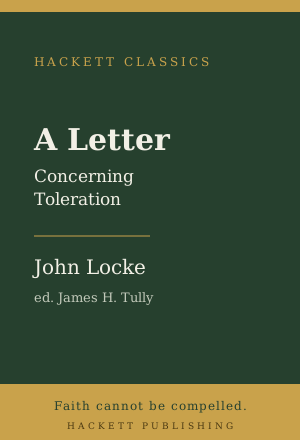
- Title
- A Letter Concerning Toleration
- Author / Editor
- John Locke; edited with an introduction by James H. Tully
- Publisher
- Hackett Publishing Company (Hackett Classics)
- Length
- ~72 pp. (text with introduction)
- Difficulty
- Intermediate ★★☆ — about two hours
Check price & availability on the Amazon product page
What it is — in three lines
Written in exile in the Netherlands and published in 1689, the Letter is Locke's short, blazing argument for religious toleration. It draws a sharp line between the business of the state (protecting our worldly goods) and the business of the church (the care of souls), and concludes that government has no authority to enforce belief. This Hackett edition, edited by James H. Tully, pairs the text with a clarifying introduction in a slim, inexpensive volume — the ideal way to read it.
The core — the magistrate, the soul, and coercion
Locke's argument turns on two claims. First, the state's whole purpose is to protect our worldly interests — life, liberty, health, and property — and nothing in that commission covers the salvation of souls. Second, coercion cannot produce belief: the magistrate can compel outward conformity, but genuine faith is an inward conviction that force can never reach. It follows that the state should not impose a creed, and that churches, as voluntary societies, must tolerate one another.
The care of souls cannot belong to the civil magistrate, because his power consists only in outward force; but true and saving religion consists in the inward persuasion of the mind.
— Locke, A Letter Concerning Toleration
It is a founding statement of what we now call the separation of church and state — and, read today, a strikingly modern one.
Three highlights
1. Short and self-contained
At around seventy pages it is the most approachable primary text on this shelf: you can read the whole argument in one sitting and feel the shape of Locke's mind at work.
2. The complement to the politics
Where the Two Treatises ground the legitimacy of political power, the Letter marks its limit. Read together, they give you the two pillars of Locke's liberalism — authority and its boundary.
3. Tully's edition
Tully is a distinguished Locke scholar, and his introduction sets the historical stakes — persecution, exile, the politics of dissent — without getting between you and the text.
What to watch out for
Two honest notes. First, Locke's toleration has limits that trouble modern readers: he explicitly withholds it from atheists and, in effect, from Catholics, on political grounds. A careful reading has to reckon with those exclusions rather than celebrate the Letter as simple ecumenism. Second, this is one argument, not the whole of Locke's politics; read it alongside the Two Treatises for the full picture. Short as it is, it rewards a second, slower pass.
Check price & availability on the Amazon product page