Home › Top 5 › Totality and Infinity
Review: Totality and Infinity — the magnum opus, read line by line
★★★★★4.7 / 5.0 (editorial rating)
Verdict: the book the whole shelf climbs toward, and one of the genuine classics of twentieth-century philosophy. Ethics grounded not in reason or law but in the face of the Other, who breaks open every "totality" as the infinite. Hard — but with Ethics and Infinity, Davis and the Reader behind you, hard in a way that rewards every hour. The rating is for the work; see the cautions for the reading.
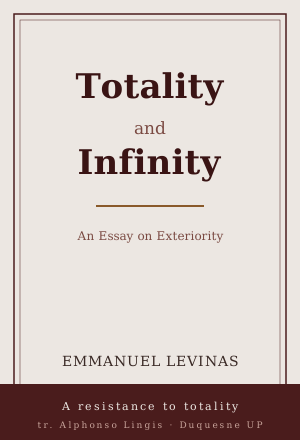
- Title
- Totality and Infinity: An Essay on Exteriority
- Author
- Emmanuel Levinas, tr. Alphonso Lingis
- Publisher
- Duquesne University Press (original: Totalité et infini, 1961)
- Length
- Primary source · ~314 pp.
- Difficulty
- Advanced ★★★ — a masterwork; do not start here
Check price & availability on the Amazon product page
What it is — in three lines
Published in 1961 as Levinas's principal thesis, this is the book that made his name. Its target is a whole tradition of Western philosophy that, in his reading, has tried to reduce everything to a single system — a "totality" — in which the other person becomes just one more object I comprehend. Against this, Levinas argues that the face-to-face encounter with the Other opens a relation to the infinite, something that exceeds my grasp and, in exceeding it, founds ethics. Lingis's is the standard English translation.
The core move: totality vs. infinity
The title names the opposition that runs through the whole book. "Totality" is the mind's drive to gather all things into one comprehensible whole, where nothing is truly other because everything can, in principle, be known and placed. "Infinity" is Levinas's word for what breaks that drive: the Other whose face I cannot reduce to my idea of them. In the encounter, I meet a resistance that is not physical but ethical — a claim on me that precedes and outranks my freedom to know and use. Ethics, on this account, is not a branch of philosophy that comes after metaphysics; it is first philosophy, the event from which everything else must be rethought.
The other person is not a larger version of me to be comprehended, but a height I cannot climb — and it is from that height, not from within my own reason, that obligation reaches me.
— editorial summary of the book's central argument
Three highlights
1. Ethics as first philosophy
The book's boldest claim is that the relation to the Other comes before knowing, not after it — a reversal of the whole modern project that starts from the knowing subject. Even where you resist it, it reorganises how you see the tradition.
2. The phenomenology of everyday life
Before the ethics, long stretches describe dwelling, enjoyment, the home, labour, the welcome of the feminine. These concrete analyses are some of the most readable pages Levinas wrote, and they are easy to miss if you rush to "the face."
3. The face, in full
What Ethics and Infinity states in a sentence is here worked out at length: why the face is not a perception but a summons, and how "you shall not kill" is written in it. This is the definitive treatment.
What to watch out for
The honest warning that governs the whole shelf: do not make this your first Levinas. The vocabulary is dense, the sentences long, and Levinas argues by accumulation rather than by numbered steps — open it cold and you will likely stall in the opening pages. It is also written partly in dialogue with Husserl and Heidegger, so a little phenomenology in the background helps. Read Ethics and Infinity, then Davis and the Reader first, and this masterwork becomes not a wall but a long, rewarding climb. A companion such as Simon Critchley's Cambridge Companion to Levinas is worth keeping to hand for the hardest sections.
Check price & availability on the Amazon product page