Home › Top 5 › Ethics and Infinity
Review: Ethics and Infinity — the best door into Levinas
★★★★★4.6 / 5.0 (editorial rating)
Verdict: the first Levinas book, with almost nothing to argue about. A hundred-odd pages in which the philosopher explains his own hardest ideas in conversation — no treatise density, no wall of jargon. If you have ever bounced off Totality and Infinity, start here and the same ideas suddenly become sayable.
- Title
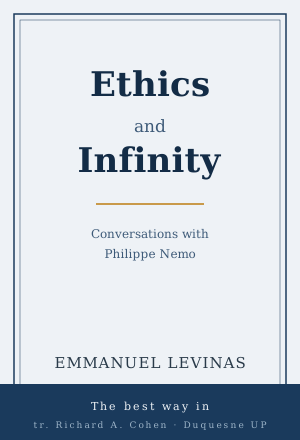
- Ethics and Infinity: Conversations with Philippe Nemo
- Author
- Emmanuel Levinas, tr. Richard A. Cohen
- Publisher
- Duquesne University Press, 1985 (from radio interviews, 1981)
- Length
- Interviews · ~120 pp. (ten conversations)
- Difficulty
- Beginner ★☆☆ — spoken, plain, and short
Check price & availability on the Amazon product page
What it is — in three lines
In 1981 the French philosopher Philippe Nemo interviewed Levinas across ten short radio programmes, and this book is their transcript. Nemo asks the direct questions a newcomer would ask; Levinas answers, walking back through his life and his central ideas — the Other, the face, responsibility, the infinite — in ordinary spoken French. The result is less a treatise than a guided conversation that carries you from his early years to the heart of his ethics.
Why it can be your first Levinas
The reason is the form. Speaking on the radio, Levinas cannot hide behind the coiled sentences of his written work; he has to say what he means, plainly, to a general audience. So the ideas that look impassable in the treatises arrive here in their simplest dress. The famous claim that ethics comes before knowledge — that my responsibility for another person is not a conclusion I reason my way to but something that has always already claimed me — is stated in a few clear sentences you can actually hold onto.
The face of the other resists my power and, before any word is spoken, commands me: you shall not kill. Responsibility comes before freedom, not after it.
— editorial summary of Levinas's argument in the interviews
You can read the whole thing in an afternoon, yet you close it holding the core of a philosophy that takes two dense masterworks to develop. For a first contact with a thinker this hard, that ratio is almost unheard of.
Three highlights
1. "The face" — the idea, in plain speech
Levinas's most famous notion — that the other person's face is not an object I perceive but an ethical summons I answer — is where beginners most often get lost in the books. Here he explains it conversationally, and it lands as an experience you recognise rather than a piece of terminology.
2. A life behind the thought
Because Nemo begins biographically, you learn where the philosophy comes from — the formation in phenomenology under Husserl and Heidegger, and the shadow of the war and the Shoah over everything that follows. That context makes the later abstraction feel motivated rather than arbitrary.
3. A preview of both masterworks
Levinas himself sketches the moves of Totality and Infinity and Otherwise than Being in miniature. Read this first and you enter each masterwork already knowing what it is trying to do.
What to watch out for
Two honest notes. First, this is an introduction by its author, not a substitute for the works. The interviews give you the shape of the ideas, not the rigorous argument; the demonstrations live in the treatises, and skipping them means taking Levinas's conclusions on trust. Second, a few passages still presuppose the phenomenological vocabulary Levinas grew up in (intentionality, Being, the trace); Cohen's short introduction and Davis's Levinas: An Introduction both help. None of this dents the recommendation — it simply marks this as the door, not the house.
Check price & availability on the Amazon product page