Home › Top 5 › Otherwise than Being
Review: Otherwise than Being — the summit of the shelf
★★★★☆4.4 / 5.0 (editorial rating)
Verdict: the final ascent — the most demanding, and most extraordinary, book Levinas wrote. Responsibility for the Other pressed past all limits into "substitution": being, before any choice, hostage to another. Not a place to begin, but the reward for readers who have made the whole climb. The rating is for the work; the cautions are serious.
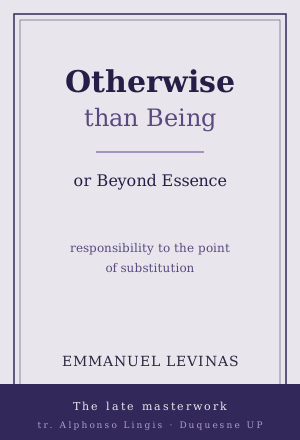
- Title
- Otherwise than Being: or Beyond Essence
- Author
- Emmanuel Levinas, tr. Alphonso Lingis
- Publisher
- Duquesne University Press (original: Autrement qu'être, 1974)
- Length
- Primary source · ~205 pp.
- Difficulty
- Advanced ★★★ — the hardest book here; read it last
Check price & availability on the Amazon product page
What it is — in three lines
Published in 1974, this is Levinas's second mature masterwork, written partly in response to criticism of Totality and Infinity — above all Derrida's argument that the earlier book still spoke the language of the very tradition it wanted to escape. In answer, Levinas changes his language itself. The key word is no longer the "face" but "substitution": the self as already, before any decision, responsible for the other to the point of standing in their place — "hostage," in his stark term. Ethics is pushed beneath being, "otherwise than being."
Why it goes further than Totality and Infinity
Where the earlier book still described the ethical relation from a certain distance, this one tries to write from inside the condition of responsibility — before the self has even fully formed as a self. The result is a prose of extraordinary intensity and difficulty: recurring terms like "the saying and the said," "proximity," "the trace," "persecution," each straining ordinary meaning. The claim is that my responsibility for the other is not something I take on but something that constitutes me, older than my freedom, my identity, even my being. It is Levinas at his most radical and least compromising.
I am responsible for the other before I am anything at all — not because I chose it, but because the self is, from the start, this being-for-another.
— editorial summary of the book's central claim
Three highlights
1. "Substitution" — the heart of the book
The central chapter, on substitution, is the conceptual core Levinas said he built the rest of the book around. It is the furthest point his ethics reaches, and worth the whole ascent.
2. The saying and the said
His distinction between the living address to another ("the saying") and its fixed content ("the said") is one of the most influential ideas in late twentieth-century thought, and it is here that he works it out.
3. A different kind of prose
The style is not obscurity by accident but by design — an attempt to write ethics without freezing it into a system. Once you accept that, the difficulty becomes part of the meaning rather than an obstacle to it.
What to watch out for
The plain truth: this is the hardest book on the shelf, and it is genuinely hard even for specialists. Do not come to it without having read Totality and Infinity first — much of it is a response to that book, and it presupposes you know the earlier vocabulary. Even then, expect to reread the central chapters, and consider working alongside a scholarly companion (Simon Critchley's Cambridge Companion to Levinas, or a dedicated commentary) for the densest stretches. This is a destination, not a starting point — but as a destination it is one of the peaks of modern ethical thought.
Check price & availability on the Amazon product page