Home › Top 5 › Levinas: An Introduction
Review: Levinas: An Introduction — the concept map before the climb
★★★★☆4.3 / 5.0 (editorial rating)
Verdict: the study to read with the primary texts at your elbow. Davis lays out the whole conceptual terrain — alterity, the Other, the face, infinity — and traces how the thought moves from the early work to the late. Crucially, he is candid about the hard parts rather than smoothing them over, which is exactly what you want before Totality and Infinity.
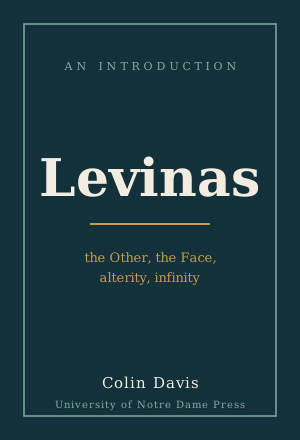
- Title
- Levinas: An Introduction
- Author
- Colin Davis
- Publisher
- University of Notre Dame Press, 1996 (also Polity, Key Contemporary Thinkers)
- Length
- Scholarly study · ~168 pp.
- Difficulty
- Intermediate ★★☆ — clear, but assumes you want the argument
Check price & availability on the Amazon product page
What it is — in three lines
Colin Davis, a scholar of modern French thought, wrote this as a single-author guide to the whole of Levinas. It takes the concepts readers stumble on — alterity, the Other, the face, infinity, the trace — and explains each in turn, then follows the arc of Levinas's thinking from the early phenomenological essays through Totality and Infinity to the later Otherwise than Being. A compact, orderly overview of a famously disorderly-seeming body of work.
Why the map matters here
Levinas reuses a small set of words in shifting, escalating senses, and the treatises rarely stop to define them. Davis does the defining for you. He does more than gloss the terms, though: he gives the book an argument of its own. His running thesis is that Levinas remains bound to the very ontological tradition he wants to break with, and that the difficult, sometimes deliberately disruptive style of the late work is Levinas's attempt to wrench free of that dependency. Whether or not you end up agreeing, having that thread in hand turns the primary texts from a fog into a series of moves you can watch being made.
The concepts are not a fixed vocabulary but a sequence of attempts; Levinas keeps re-saying the Other because no single formulation can hold it still.
— editorial summary of Davis's reading
Three highlights
1. The concepts, defined and connected
Alterity, the face, the infinite, substitution — each gets a clear treatment, and, more usefully, Davis shows how they hang together. That connective tissue is precisely what the treatises leave implicit.
2. Early → late, as one story
By tracing six decades in order, Davis lets you see why Levinas moved from the language of Totality and Infinity to the more extreme idiom of Otherwise than Being. The late turn stops looking like obscurity for its own sake.
3. A critic, not a fan
Davis presses on the strains and unresolved tensions in Levinas. An introduction that argues rather than merely admires is better preparation for reading the man himself with your own eyes open.
What to watch out for
Two honest notes. First, this is a study, not a first taste. If you have not yet met Levinas at all, read Ethics and Infinity first; Davis assumes you want the argument, not the mood. Second, other fine introductions exist — Simon Critchley's edited Cambridge Companion to Levinas is the standard multi-author survey — and you need only one at this stage. We rank Davis's single-voice book highest here because its continuous argument is the most useful thing to carry into the primary texts.
Check price & availability on the Amazon product page