Home › Top 5 › The Levinas Reader
Review: The Levinas Reader — Levinas in his own words, at essay length
★★★★☆4.2 / 5.0 (editorial rating)
Verdict: the bridge from reading about Levinas to reading Levinas. A career-spanning anthology of his own texts, each with a short editorial introduction — so you get his voice in doses short of a whole treatise, and arrive at the masterworks already used to how he writes.
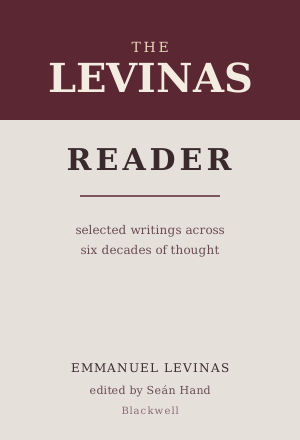
- Title
- The Levinas Reader
- Editor
- Seán Hand (texts by Emmanuel Levinas)
- Publisher
- Blackwell (Blackwell Readers)
- Length
- Anthology · ~320 pp. (read selectively)
- Difficulty
- Intermediate ★★☆ — primary texts, but guided and short
Check price & availability on the Amazon product page
What it is — in three lines
Seán Hand, a Levinas scholar and translator, gathers texts from across the whole span of Levinas's career and arranges them so a reader can see the range of his work: early phenomenological studies written under Husserl and Heidegger, the mature ethical critique, essays on art and aesthetics, readings of the Talmud, and pieces on politics. Hand's general introduction places Levinas as a whole, and each selection carries its own short preface. One volume, most of the territory.
Why a reader, at this step
An introduction tells you what Levinas thinks; only Levinas shows you how he thinks — the circling repetitions, the sudden intensities, the way an argument is also almost a liturgy. Meeting that style for the first time inside a 300-page treatise is where many readers drown. A reader lets you meet it in a fifteen-page essay instead, with a guide's hand on your shoulder. You can also sample the different Levinases here — phenomenologist, ethicist, Talmudic commentator — and find out which one you most want to pursue before you commit to a whole book.
Read one essay, then its introduction again: the second pass is where his rhythm stops being an obstacle and starts being the argument.
— editorial note on how to use the anthology
Three highlights
1. Breadth in one volume
Phenomenology, ethics, aesthetics, Judaism, politics — the anthology shows that Levinas was not only the philosopher of the face, and that the ethics grows out of a much wider body of work.
2. Guided, not dumped
Hand's prefaces situate each text, so you are never dropped into a difficult essay without bearings. This is the difference between a reader and simply photocopying the hard chapters.
3. A rehearsal for the treatises
By the time you have read several selections, the prose of Totality and Infinity feels like a known language rather than a foreign one. That acclimatisation is the whole point of this step.
What to watch out for
Two honest notes. First, an anthology is selections, not a single sustained argument; it prepares you for the masterworks but does not replace them, and the excerpting means you lose the long build of a full treatise. Second, don't try to read it cover to cover in order like a novel — use it as designed, essay by essay, following your interest. The Talmudic readings in particular assume a context most newcomers won't have, so it's fine to leave them for later.
Check price & availability on the Amazon product page