HEIDEGGER BOOK GUIDE
The 5 Best Heidegger Books (2026)
— and a reading order for Being and Time
Martin Heidegger, the twentieth century's most influential — and most forbidding — philosopher. His masterwork, Being and Time, forged half the vocabulary of modern thought, and it is also one of the most reliably abandoned books in philosophy. The short answer: do not start with Being and Time. Here are five books, from an accessible introduction to the primary text, in an order built so you can actually arrive.
The editorial room behind this site read Being and Time's Introduction section by section (§1–§7) on our sister archive An Easy Reading of "Being and Time" (nine free articles, in Japanese). Every recommendation here rests on that first-hand reading.
Our RankingRANKING
The editorial order. If you can't decide, start at #1. Check prices and availability on the Amazon product pages.
-
1
 If in doubt, start hereBeginner–Intermediate
Heidegger: An Introduction
A leading Heidegger translator maps the entire career — the early Being and Time, the "turn," and the late thinking of Being — in one calm, honest volume. The single most reliable map to carry into everything else on this page.
Check price & availability on Amazon
View on Amazon Read our review -
2
 BeginnerIllustrated
Introducing Heidegger: A Graphic Guide
The hardest ideas — Dasein, being-in-the-world, the "they," being-towards-death — one idea per illustrated spread. An hour that lets you see the summit before the climb, and lowers the failure rate of every later book.
Check price & availability on Amazon / Kindle edition available
View on Amazon Read on Kindle Read our review -
3
 Intermediate
The Routledge Guidebook to Heidegger's Being and Time
A section-by-section commentary that walks alongside the primary text, in the order Heidegger wrote it. When you stall on a passage, this is the book that tells you what is happening on that page. The companion for anyone actually attempting Being and Time.
Check price & availability on Amazon
View on Amazon Read our review -
4
 Intermediate
Heidegger: A Very Short Introduction
Short, but not soft. Inwood, author of A Heidegger Dictionary, takes the concepts one at a time and pins down what each actually means. Pair it with Polt's map and you have the width of Heidegger interpretation in your hands.
Check price & availability on Amazon
View on Amazon Read our review -
5
 Advanced
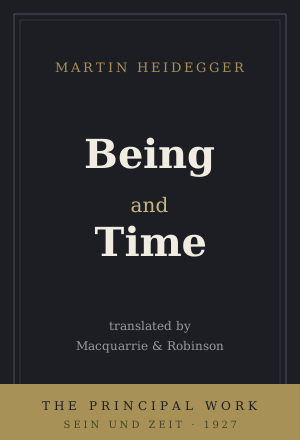
Being and Time
Being-in-the-world, the "they," being-towards-death, temporality — it all comes from this unfinished masterwork. The four books above exist to get you here. Buy it first and you stall where every reader stalls; climb the stairs first and it becomes the full version of a view you already know.
Check price & availability on Amazon
View on Amazon Read our review
The 5 Books at a GlanceCOMPARE
The biggest worry with philosophy books is "can I actually read this?" Choose by difficulty and format.
| Title | Difficulty | Length | Type | Best for | Links |
|---|---|---|---|---|---|
| Heidegger: An IntroductionRichard Polt · Cornell UP | Beginner–Intermediate ★★☆ | ~200 pp. ~6 hrs |
Overview (whole career) | You want one trustworthy map first | View on Amazon Review |
| Introducing Heidegger: A Graphic GuideCollins & Selina · Icon | Beginner ★☆☆ | 176 pp. ~1 hr |
Illustrated guide | You want to see the summit before the prose | View on Amazon Review |
| The Routledge Guidebook to Being and TimeStephen Mulhall · Routledge | Intermediate ★★☆ | ~220 pp. ~9 hrs |
Reading guide (commentary) | You want a companion for the primary text | View on Amazon Review |
| Heidegger: A Very Short IntroductionMichael Inwood · OUP | Intermediate ★★☆ | 176 pp. ~5 hrs |
Concept-led introduction | You want the concepts defined precisely | View on Amazon Review |
| Being and Timetr. Macquarrie & Robinson · Harper Perennial | Advanced ★★★ | 589 pp. months |
Original (principal work) | You are ready for the book itself | View on Amazon Review |
A Reading Order That Won't Defeat YouROADMAP
There is essentially one reason people give up on Heidegger: they start with Being and Time — a wall of invented vocabulary, entered without a map or a companion. Climb in three steps instead.
-
STEP 1 ── The view and the map (one or two books)
See the summit in the Graphic Guide, then get your bearings with Polt
The Graphic Guide shows you being-towards-death and the "they" in an hour of pictures; Polt then gives you the whole career as a single honest map. Together they turn Heidegger's vocabulary from a wall into a landscape.
Graphic Guide on AmazonPolt on Amazon -
STEP 2 ── Get a companion (books 3–4)
Mulhall for the running commentary, Inwood for the concepts
Mulhall walks passage by passage alongside Being and Time; Inwood pins down what each key term actually means. Two readings run in parallel, so when the primary text stops you there is more than one line back in.
Mulhall on AmazonInwood on Amazon -
STEP 3 ── The principal work (the goal)
Take on Being and Time — with Mulhall open beside it
Start with the Macquarrie & Robinson translation and keep Mulhall to your right. The first wall is the Introduction (§1–§8); once you are through it, the analysis of tools and the "they" is genuinely a pleasure to read. Our sister archive's section-by-section reading of the Introduction (free, in Japanese) can run alongside.
View on AmazonRead our review
How We ChoseCRITERIA
Three criteria. First, currently in print and actually available on amazon.com — every title has a live product page from an established publisher (Cornell, Icon, Routledge, Oxford, Harper). Second, the ladder must hold: view → map → companion → principal work, each step preparing the next, with entry points at every height from an illustrated guide to a 589-page original. Third, honesty about what each book is: a graphic guide is scaffolding, a commentary is a companion, and the reviews say so — and, crucially, name their line of interpretation so you can read them against each other. The editorial room read Being and Time's Introduction (§1–§7) section by section on our sister archive; that first-hand reading is the foundation here.
Still Undecided? Take This OneCONCLUSION
If you have read this far and still can't choose, the answer is simple: buy Polt's Heidegger: An Introduction. It is the one map that covers the whole career from a scholar who also translates the man, and by the last page you will know what you actually want to read next. If plain prose still feels like too much, start with the Graphic Guide and its one-hour tour of the summit.
Check price & availability on the Amazon product pages