Review: Being and Time — read it last. But read it.
★★★★☆4.4 / 5.0 (editorial rating)
Verdict: the goal of this whole bookshelf — and, strictly, the last book on it. Being-in-the-world, the "they," being-towards-death, temporality: much of the vocabulary of twentieth-century thought was cast in this unfinished work. Climb the four steps above first and it reads as the full version of a view you already know. Open it first, and you stall exactly where every reader before you stalled.
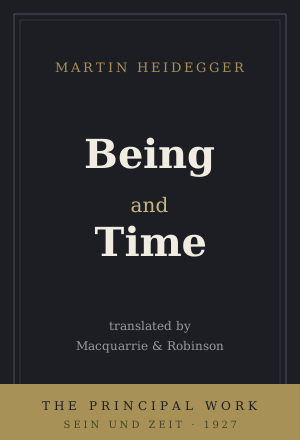
- Title
- Being and Time
- Author / translator
- Martin Heidegger; translated by John Macquarrie & Edward Robinson
- Publisher
- Harper Perennial Modern Thought (this translation first published 1962; original Sein und Zeit, 1927)
- Length
- 589 pp. — a climb measured in months
- Difficulty
- Advanced ★★★ — the hardest book on this site, by design
Check price & availability on the Amazon product page
What it is — in three lines
Published in 1927, when Heidegger was thirty-seven, this is his principal work. To reopen the question of the meaning of Being — a question, he says, that philosophy has forgotten since the Greeks — he first analyses the being for whom Being is a question at all: the human being, Dasein. And the book is unfinished: the promised later part was never published, and that very incompleteness went on to shape twentieth-century philosophy.
The whole, in one map
Introduction: reawaken the question of Being (§§1–8). Division One: the analysis of everyday existence — being-in-the-world, tools, the "they." Division Two: the turn toward authenticity — being-towards-death, conscience, resoluteness, and finally temporality. Here the published text breaks off.
— The editorial room's one-line map
Our sister archive reads the Introduction (§§1–7) section by section (free, in Japanese) — a chance to scout the first ascent before you buy. It is the exact stretch where most readers stop, so seeing it walked through first is worth an evening.
Three things to read for
1. The analysis of tools (Division One)
A hammer is a thing-in-use before it is a thing-observed; the world is already understood as a field for living before it is an object of study. This analysis rippled out across twentieth-century philosophy, cognitive science and even design theory. The moment your ordinary surroundings start to look different, it usually starts here.
2. The "they" (das Man)
The pages around §27, which describe everyday life as the quiet rule of an anonymous "everyone," read like an anatomy of the social-media age written a century early. Readers are routinely startled that a description this old dissects a mood this current.
3. From being-towards-death to temporality (Division Two)
By anticipating one's own death, a life switches from "anyone's life" to "my life" — the summit of the book. Heidegger then draws out temporality as the condition that makes such existence possible, and the "Time" of the title is finally cashed in.
Where you stall — and choosing a translation
The failure mode is predictable: the density of the Introduction (§§1–8) stops readers cold. Cross it with Mulhall's guidebook to your right and our sister archive to your left; once you are through, Division One's tool analysis is genuinely enjoyable. On the English text itself, there are two standard choices. Our pick is the one reviewed here — Macquarrie & Robinson (Harper Perennial), the 1962 translation that is still the most widely cited and the one whose terms (readiness-to-hand, the "they," being-towards-death) most secondary literature — including Mulhall — assumes. The main alternative is the Joan Stambaugh translation, revised by Dennis J. Schmidt (SUNY Press), which many find more readable in places. Either will get you up the mountain; only not choosing will not.
Check price & availability on the Amazon product page