Home › Top 5 › Inwood's Very Short Introduction
Review: Heidegger: A Very Short Introduction — short, but not soft
★★★★☆4.0 / 5.0 (editorial rating)
Verdict: the concept dictionary in essay form. Michael Inwood, who literally wrote A Heidegger Dictionary, takes the key terms one at a time and makes each one precise. For the reader who wants to know exactly what a word like "thrownness" carries — and who is not fooled by the word "short" into expecting easy.
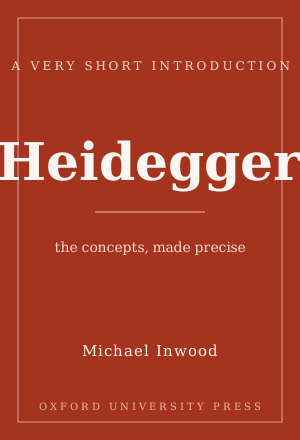
- Title
- Heidegger: A Very Short Introduction
- Author
- Michael Inwood (1944–2021; fellow of Trinity College, Oxford; author of A Heidegger Dictionary)
- Publisher
- Oxford University Press (Very Short Introductions series)
- Length
- 176 pp.
- Difficulty
- Intermediate ★★☆ — small book, full-strength ideas
Check price & availability on the Amazon product page
What it is — in three lines
A pocket-sized introduction organised around Heidegger's ideas rather than his biography: Being, Dasein, world, time, death, language, truth. Its author spent years compiling A Heidegger Dictionary, and it shows — the book's real strength is definitional exactness, getting each strange term to sit still long enough to be understood. Roughly two hundred small pages that repay slow reading.
Why a concept-led introduction earns its place
Because half of what defeats readers of Heidegger is vocabulary that seems deliberately opaque — and it is not opaque so much as unusually exact. Inwood's gift is to show that the coinages are doing precise work, and to say what that work is.
We never begin from nowhere: we always already find ourselves thrown into a situation, in a mood, mattering to ourselves before we have chosen anything.
— Heidegger, Being and Time §29, on thrownness and attunement (editorial gloss of the German original)
A term like "thrownness" (Geworfenheit) can look like jargon until someone shows you the ordinary fact it names. That is Inwood's characteristic move, performed on term after term — which is exactly the service a first reader needs.
Three highlights
1. Definitional precision
No one currently writing is better at saying what a given Heideggerian word does and does not mean. If you have been tripping over "the ontological difference" or "the ready-to-hand," this is the book that stops the tripping.
2. It reads across the whole career
Inwood does not confine himself to Being and Time; he draws on the later work on language, truth and technology too, so the concepts are shown in their mature as well as their early form. It complements Polt's narrative map with a conceptual one.
3. An interpretive line of its own
Inwood reads Heidegger with a philosopher's willingness to test the arguments and to flag where the language strains. Set beside Mulhall's passage-by-passage reading, you get two independent angles on the same text rather than one received summary.
What to watch out for
Two honest notes. First, "very short" does not mean "very easy." The compression can make the book dense — it rewards the reader who already has a rough picture (from the Graphic Guide or Polt) more than the absolute beginner. Second, because it is organised by concept rather than by the text, it is not a substitute for a running commentary on Being and Time; for that, keep Mulhall beside the original. Use Inwood as the dictionary, Mulhall as the walking guide.
Check price & availability on the Amazon product page