Home › Top 5 › Heidegger: An Introduction
Review: Heidegger: An Introduction — the whole career in one honest map
★★★★☆4.3 / 5.0 (editorial rating)
Verdict: the right first book. A leading Heidegger translator lays out the entire career — the early Being and Time, the "turn," the late thinking of Being — in one calm volume that never pretends the man is simpler, or safer, than he is. For anyone who wants a single trustworthy map before choosing where to dig.
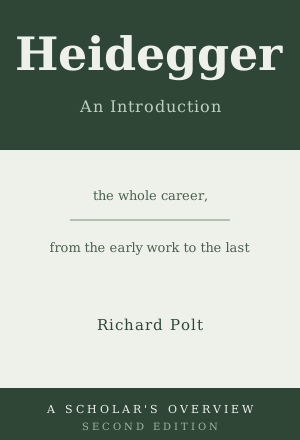
- Title
- Heidegger: An Introduction
- Author
- Richard Polt (professor of philosophy, Xavier University; co-translator of Heidegger's Introduction to Metaphysics)
- Publisher
- Cornell University Press (2nd edition, 2025; first edition 1999)
- Length
- around 200 pp.
- Difficulty
- Beginner–Intermediate ★★☆ — clear prose, serious content
Check price & availability on the Amazon product page
What it is — in three lines
Richard Polt, a philosopher who has spent a career translating and teaching Heidegger, walks the reader through the whole of his thought in a single introductory volume. It does not stop at Being and Time: it carries on into the "turn" (the Kehre), the later meditations on technology, language and the history of Being, and it does not skip the Nazi involvement. Clear enough for a first reader, honest enough for a serious one.
Why start with a map of the whole career
Because the single most common mistake with Heidegger is to treat Being and Time as the whole of him — and then to be baffled when the later writing seems to speak another language. Polt puts the early book where it belongs: as one ambitious, unfinished stage in a lifelong single question.
The question of the meaning of Being — the question that antiquity asked and then let fall asleep — has today been forgotten, and this book means to wake it.
— Heidegger, Being and Time, Introduction §1 (editorial gloss of the German original)
Hold onto that one question and the whole career becomes legible: the analysis of human existence in Being and Time was only ever the approach road, and the later work is what happens when the road is rebuilt. Polt is the guide who keeps that question in view from the first page to the last.
Three highlights
1. The question of Being, kept in the foreground
Polt never lets the vocabulary become the point. Dasein, thrownness, the "they," being-towards-death — each is introduced as a move within the one question, so the terms arrive as tools rather than as obstacles. That is exactly what a first reader needs.
2. It carries you past Being and Time
Most introductions stop where the famous book stops. Polt keeps going into the "turn" and the late thinking, which is where the received image of Heidegger — technology, "the fourfold," language as "the house of Being" — actually comes from. You finish with the shape of the whole, not just the opening chapter.
3. The scholar's honesty about the politics
The chapter on Heidegger's Nazi involvement neither excuses it nor uses it to wave the philosophy away. For a reader deciding whether this thinker is worth their months, that candour is worth a great deal.
What to watch out for
Two honest notes. First, this is an overview, not a line-by-line commentary: it gives you the map, not the walk through Being and Time passage by passage. That is what Mulhall's guidebook is for. Second, "introduction" does not mean "easy read" — the sentences are clear, but the ideas are still Heidegger's, and Polt respects them enough not to water them down. If you want the concepts pre-chewed into pictures first, begin with the Graphic Guide and come back.
Check price & availability on the Amazon product page