Home › Top 5 › Mulhall's Guidebook
Review: The Routledge Guidebook to Heidegger's Being and Time — the companion for the climb
★★★★☆4.2 / 5.0 (editorial rating)
Verdict: the one book to keep open beside the original. Stephen Mulhall follows Being and Time in Heidegger's own order and, section by section, says what is actually going on. For anyone who has decided to attempt the primary text and does not want to climb it alone.
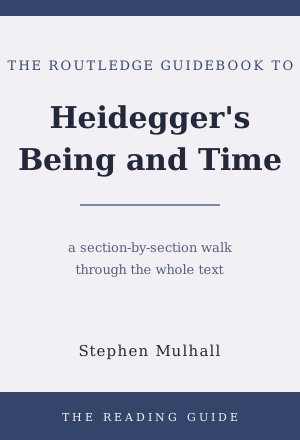
- Title
- The Routledge Guidebook to Heidegger's Being and Time
- Author
- Stephen Mulhall (professor of philosophy, New College, Oxford)
- Publisher
- Routledge (2nd edition, 2013; earlier editions in the Routledge Philosophy Guidebook series)
- Length
- around 220 pp.
- Difficulty
- Intermediate ★★☆ — reads best next to the text it explains
Check price & availability on the Amazon product page
What it is — in three lines
A dedicated guidebook to a single work: it takes Being and Time from the Introduction through the analysis of everyday existence to being-towards-death and temporality, in the order Heidegger wrote it, explaining each stretch as it comes. Not an overview of the man and not a themed introduction — a walking companion for the one book. Long a standard in university courses on Being and Time.
Why a running commentary is the thing that gets you through
Because the way people fail at Being and Time is specific: they stall on a paragraph, cannot tell whether they have missed something or whether Heidegger is merely being Heidegger, and quietly close the book. A commentary that tracks the text page by page removes exactly that failure mode — it answers "what is happening here?" at the moment the question arises.
The hammer is understood not by staring at it but by hammering; in use it withdraws, and the world of workshop and task shows up through it. Only when it breaks do we notice the thing itself.
— Heidegger, Being and Time §§15–16, on the ready-to-hand (editorial gloss of the German original)
Passages like that reward a guide who can say plainly what the example is doing in the argument. Mulhall is that guide: he keeps the thread of the whole while explaining the step in front of you.
Three highlights
1. It runs in the text's own order
Because the commentary follows Heidegger's sequence, you can read the two side by side: a stretch of Being and Time, then Mulhall on that stretch. The stalling stops, and the book starts moving.
2. It is a philosopher's reading, not a paraphrase
Mulhall is a serious philosopher in his own right, and he argues with the text as well as explains it — so you come away not just knowing what Heidegger said but with a sense of where the pressure points are. That is more useful, in the end, than a flat summary.
3. It has a clear line — and tells you so
Mulhall reads Being and Time with a distinctive emphasis on authenticity, death and the first-person stakes of the analysis. Set it beside Polt's whole-career overview and Inwood's concept-by-concept precision, and you get the width of the interpretive field rather than a single fixed answer.
What to watch out for
Two honest notes. First, it is a companion, not a substitute: read alone, without Being and Time open beside it, it is much less than it is meant to be. Buy it to read with the original, not instead of it. Second, it is a reading, not the reading — Mulhall's emphasis is one respected line among several, which is exactly why we pair it with Polt and Inwood on this site. If you have not yet decided to attempt the primary text at all, start further down the ladder with the Graphic Guide and Polt.
Check price & availability on the Amazon product page