HEGEL BOOK GUIDE
The 5 Best Hegel Books (2026)
— from a Very Short Introduction to the Phenomenology, in reading order
Hegel is the philosopher everyone means when they say a book is "impossible." He wrote in dense German, and his central idea — the dialectic, in which anything carries its own opposite inside it and climbs through the conflict to a higher stage — is easy to parody ("thesis, antithesis, synthesis") and hard to actually grasp. But there is a way in. Start with a hundred-page introduction, not the six-hundred-page masterpiece. Five real English editions, from Peter Singer's Very Short Introduction to the Phenomenology of Spirit and the Philosophy of Right, in an order built so the hard books arrive only once you can read them.
The editorial room behind this site runs a family of philosopher bookshelves, all built on one rule: the wrong first book is how people quit philosophy. With Hegel that rule is sharpest of all. If you want to widen out from Hegel to German Idealism and Western philosophy generally, the general Philosophy Bookshelf takes over from here.
Our RankingRANKING
The editorial order. If you can't decide, start at #1. Check prices and availability on the Amazon product pages.
-
1
 If in doubt, start hereBeginner
Hegel: A Very Short Introduction
The single best entry point. Singer takes the reputation for impossibility head-on and explains, in a hundred and thirty pages, what Hegel was actually trying to do — the dialectic, spirit (Geist), freedom, and history — without hiding behind "thesis-antithesis-synthesis." The map you need before any of the primary texts.
Check price & availability on Amazon / Kindle edition available
View on Amazon Read on Kindle Read our review -
2
 Intermediate
Introduction to the Philosophy of History
Hegel in his own words, at his most readable. These are the opening lectures on world history — the famous claim that history is "the progress of the consciousness of freedom," moved along by the "cunning of reason." Because it was spoken to students, it flows where the masterpieces grind. The best first taste of the real Hegel.
Check price & availability on Amazon / Kindle edition available
View on Amazon Read on Kindle Read our review -
3
 Advanced
Phenomenology of Spirit
The masterpiece, and a landmark of the whole Western tradition. Consciousness sets out from naive "sense-certainty," stumbles again and again, and each time overcomes itself on the climb toward "absolute knowing" — including the famous master–slave dialectic. Hard, but with the first two books as footing, the standard Miller translation becomes a book you can return to for life.
Check price & availability on Amazon
View on Amazon Read our review -
4
 Advanced
Elements of the Philosophy of Right
The summit of Hegel's political philosophy. From the abstract "right" of the individual, through morality, to the ethical order of family, civil society, and state, he shows how freedom becomes real not as an inner idea but as institutions. The scholarly Cambridge edition, with Wood's apparatus. The most demanding book on the shelf — and the destination once the other four are behind you.
Check price & availability on Amazon / Kindle edition available
View on Amazon Read on Kindle Read our review -
5
 Advanced
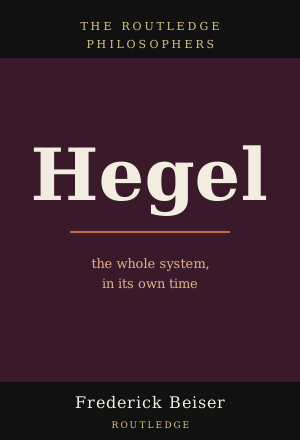
Hegel (The Routledge Philosophers)
Once you have read Hegel, read this to hold it together. Beiser, a leading historian of German Idealism, sets the whole system — metaphysics, logic, politics, history — back in Hegel's own time and problems, correcting the caricatures. Not an entry point but a deepening: the single-volume scholarly study to consolidate everything the primary texts opened up.
Check price & availability on Amazon / Kindle edition available
View on Amazon Read on Kindle Read our review
The 5 Books at a GlanceCOMPARE
The biggest fear with Hegel is opening a masterpiece and giving up on page ten. Choose by difficulty and type — and climb in order.
| Title | Difficulty | Length | Type | Best for | Links |
|---|---|---|---|---|---|
| Hegel: A Very Short IntroductionPeter Singer · OUP | Beginner ★☆☆ | ~131 pp. ~4 hrs |
Introduction | You want the map of the dialectic before anything else | View on Amazon Review |
| Introduction to the Philosophy of Historytr. Leo Rauch · Hackett | Intermediate ★★☆ | ~106 pp. ~5 hrs |
Primary (lectures) | You want the real Hegel, readable, as a story of freedom | View on Amazon Review |
| Phenomenology of Spirittr. A. V. Miller · OUP | Advanced ★★★ | ~640 pp. weeks |
Primary (masterpiece) | You want the great early masterpiece, with footing under you | View on Amazon Review |
| Elements of the Philosophy of Righted. Wood · tr. Nisbet · Cambridge | Advanced ★★★ | ~514 pp. weeks |
Primary (with apparatus) | You want the political summit: right, morality, ethical life | View on Amazon Review |
| Hegel (The Routledge Philosophers)Frederick Beiser · Routledge | Advanced ★★★ | ~364 pp. ~10 hrs |
Scholarly study | You have read Hegel and want the whole system pulled together | View on Amazon Review |
A Reading Order That Won't Defeat YouROADMAP
People fail at Hegel for one reason: they open a masterpiece first. The Phenomenology and the Philosophy of Right are unreadable without the framework — the dialectic, and key words like spirit and ethical life that Hegel uses in his own way. Get the map, then the story, then the masterpiece, then the political summit and a study to consolidate. Climb in four steps.
-
STEP 1 ── Get the map (one book)
Read Singer's Very Short Introduction
Start with Peter Singer's Hegel: A Very Short Introduction, where the dialectic, spirit, and Aufhebung ("sublation") are explained from the problems that forced them on Hegel — not drilled as a slogan. Once you hold this map, the same words in the harder books suddenly carry meaning.
Very Short Introduction on Amazon -
STEP 2 ── See the whole as a story (book 2)
Read the Introduction to the Philosophy of History
With the map in hand, meet Hegel in his own words at his most readable. The lectures on world history run on one thread — history as "the progress of the consciousness of freedom" — so you feel where Hegel's thought is heading before you face a masterpiece. This is the bridge.
Philosophy of History on Amazon -
STEP 3 ── The masterpiece (book 3)
Take on the Phenomenology of Spirit
Now the great early work. The Phenomenology follows consciousness as it stumbles and overcomes itself, stage by stage, up to "absolute knowing." Read it for the one spine — "consciousness trips, and climbs" — marking hard passages and moving on. With the first two books behind you, the master–slave dialectic reads with real traction.
Phenomenology on Amazon -
STEP 4 ── The political summit, and a study to consolidate (the goal)
The Philosophy of Right, then Beiser's Hegel
Finish with the Philosophy of Right — abstract right, morality, and the ethical life of family, civil society, and state, where freedom becomes real as institutions. Then read Frederick Beiser's Hegel to pull the whole system together and correct the caricatures. From here, the general Philosophy Bookshelf widens the view to German Idealism and beyond.
Philosophy of Right on AmazonBeiser's Hegel on Amazon
How We ChoseCRITERIA
Three criteria. First, currently in print and actually available on amazon.com — every title has a live product page from an established publisher (Oxford, Hackett, Cambridge, Routledge). Second, the ladder must hold: introduction → readable lectures → the masterpiece → the political summit → a study to consolidate, each step preparing the next, so the hardest books arrive only once you can read them. Third, honesty about the difficulty. Hegel is genuinely hard, and we say so book by book: the two masterpieces (the Phenomenology and the Philosophy of Right) will defeat you if you open them without footing, and our star ratings measure a book's achievement and usefulness, not its "readability." Ratings are the editorial room's own — no Amazon customer reviews are reproduced — and the basis for each (first-hand reading, bibliographic checking) is stated in every review's editorial note.
Still Undecided? Take This OneCONCLUSION
If you have read this far and still can't choose, the answer is simple: start with Peter Singer's Hegel: A Very Short Introduction. A hundred and thirty pages that take the "impossible" reputation head-on and hand you the dialectic, spirit, and freedom as working ideas rather than slogans — the least likely first book to defeat you. Once "the truth is the whole" clicks into place — that a whole rises up by passing through its own oppositions — the Phenomenology and the Philosophy of Right will finally answer to you.
Check price & availability on the Amazon product pages