Home › Top 5 › Philosophy of History
Review: Introduction to the Philosophy of History — the real Hegel, and readable
★★★★★4.5 / 5.0 (editorial rating)
Verdict: if you want your first experience of reading Hegel — his own words, not a summary — to succeed, start here. These are lectures, so instead of the taut prose of the masterpieces they unfold as Hegel talking to a room. One thread runs through everything: "world history is the progress of the consciousness of freedom." Grasp that, and you can see where all of Hegel is heading. In Leo Rauch's compact Hackett translation, it is the bridge from an introduction to the primary texts.
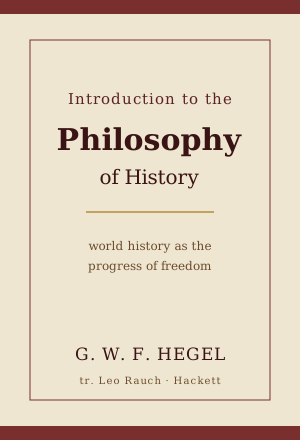
- Title
- Introduction to the Philosophy of History (with selections from The Philosophy of Right)
- Author
- G. W. F. Hegel, translated by Leo Rauch
- Publisher
- Hackett Publishing (1988)
- Length
- ~106 pp.
- Difficulty
- Intermediate ★★☆ — far more readable than the masterpieces; the book to grasp the whole picture
Check price & availability on the Amazon product page
What it is — in three lines
This is the introduction Hegel gave to his Berlin lectures on world history, reconstructed from his manuscripts and students' notes. Because it was spoken, it flows in a way the works he polished for print do not, and it argues from concrete history — the ancient East, Greece, Rome, the modern European world. Hegel's aim is to show that history is not a heap of events but the staged self-realization of a single principle: freedom. It is the best place to take in Hegel's picture as a whole for the first time. The Hackett volume adds selections from the Philosophy of Right.
The core — history as the progress of freedom
At the centre is one thesis: "world history is the progress of the consciousness of freedom." For Hegel, history is not random; a reason (he calls it the world-spirit) runs through it. But reason does not impose order from above — it works through the passions and interests of individuals, using them as its instruments and realizing freedom as an unintended result. This working-through-us Hegel names the "cunning of reason."
And the movement has a direction: from the despotism in which one is free, through the ancient world in which some are free, to the modern recognition that all are free. The scheme carries much a modern reader must reject — its Eurocentrism above all — but the sheer ambition of reading meaning and direction into history is what proved so influential. Read it and you feel the dialectic not as abstract logic but as a frame for actual history.
World history is nothing but the progress of the consciousness of freedom. Reason realizes freedom by using the passions of individuals as its instruments, beyond what any of them intend. (an editorial summary of the book's central claim)
— the backbone of the Philosophy of History lectures (editorial gloss)
Three highlights
1. Readable Hegel that is still real Hegel
Lectures let Hegel breathe. You get his own voice and his central ideas without the compression that defeats first readers of the Phenomenology — and it is short.
2. Thought that rises from concrete history
The argument moves through real states and eras, not pure logic, so a beginner always has something to hold. You see how Hegel's thinking meshes with the actual world.
3. You come away with the whole map
Freedom, spirit, reason — you watch the key words at work inside one story, world history, so that before you open a masterpiece you already sense the direction Hegel's thought travels.
What to watch out for
Two honest notes. First, readable does not mean lightweight, and the content includes claims — the Eurocentrism, the one-sided verdicts on non-European peoples — that no serious reader can accept today. Take the "progress of freedom" as the spine, don't get stuck adjudicating every historical detail, and read the scheme critically: it shows both how far a nineteenth-century mind could see and where it was bound by its time. Second, do not mistake this readable overview for the whole of Hegel. It is a grand map; the rigorous frame is in the masterpieces. Confirm it in the Phenomenology of Spirit.
Check price & availability on the Amazon product page