Home › Top 5 › Philosophy of Right
Review: Elements of the Philosophy of Right — where freedom becomes institutions
★★★★☆4.4 / 5.0 (editorial rating)
Verdict: the masterpiece of Hegel's later period and the summit of his political philosophy. From the abstract "right" of the individual, through inner "morality," he builds to the order of "ethical life" (Sittlichkeit) — family, civil society, state — showing how freedom becomes real not as an inner idea but as institutions. The most demanding book on the shelf, and the destination once the other four are behind you. A preface famous enough to be read as either conservative or radical marks its extraordinary reach. The stars are for reach; the difficulty is rated frankly as top-level.
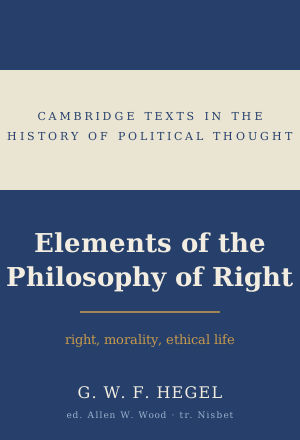
- Title
- Elements of the Philosophy of Right
- Author
- G. W. F. Hegel, edited by Allen W. Wood, translated by H. B. Nisbet
- Publisher
- Cambridge University Press (Cambridge Texts in the History of Political Thought, 1991)
- Length
- ~514 pp.
- Difficulty
- Advanced ★★★ — easy to abandon without footing; attempt it prepared
Check price & availability on the Amazon product page
What it is — in three lines
Published in 1821, the Philosophy of Right is the masterpiece of Hegel's later period, a systematic statement of his philosophy of politics, society, and law. "Right" (Recht) here is broad — not statute alone but rights, morality, and the whole ethical order. From the individual's abstract right, through inner morality, Hegel advances to the concrete community of family, civil society, and state — "ethical life" — tracing how freedom is realized not as a mere idea but within actual institutions and communities. One of the most influential classics ever written on modern civil society and the state. This Cambridge edition, edited by Allen Wood, adds the apparatus that makes the text workable.
The core — from abstract right to ethical life
The skeleton is a three-step development: abstract right → morality → ethical life. In abstract right, a person appears as a bearer of rights through property and contract — but this is formal, without inner content. In morality, the person acts on will and conscience toward the good — but runs aground on the fact that no individual can fully determine, alone, what the good is.
The place where this conflict is overcome is ethical life: the order of a community that actually binds people beyond their private subjectivity. Hegel draws it in three stages — the family, grounded in love; civil society, where individuals compete to satisfy their needs; and the state, which contains and raises both to a higher unity. His account of civil society, where self-interested wants collide, is still read as a sharp diagnosis of the modern economy. Freedom, in the end, is realizing yourself within the institutions of a community — that thought of ethical life is the book's heart.
Freedom that stays an inner idea is incomplete. It becomes real only when it is given shape in the ethical order — family, civil society, and state. (an editorial summary of the book's central claim)
— the backbone of the Philosophy of Right (editorial gloss)
Three highlights
1. A clear spine beneath the difficulty
"Abstract right → morality → ethical life," and within that "family → civil society → state": grasp this double backbone and you keep your bearings anywhere in the mass of argument.
2. The pioneering account of civil society
Making "civil society" — the arena of private need — a theme in its own right is a major achievement, and its view of the light and shadow of the modern economy ran deep into later social thought, Marx above all.
3. A reach that keeps the debate open
The preface's famous line — "what is rational is actual" — can be read as defence of the established order or as the logic of its transformation. That breadth is exactly why the book is still argued over. Wood's editorial notes help you weigh the disputes.
Where people give up — and how to read it
Defeat almost always has one cause: dutifully chasing the numbered paragraphs, statute by statute, from a standing start. The book is built of numbered sections with attached remarks and additions, and it is easy to sink into the detail and lose the whole. Better: a first pass carried by the double spine — "abstract right → morality → ethical life," "family → civil society → state" — taking the large flow. Save the detail for later readings. And — this matters — do not open it first. The reason this shelf puts an introduction through the Phenomenology ahead of it is that with the dialectic and the feel of "through opposition to a higher stage" in hand, this system book suddenly stands up on a single spine. The account of the state carries the marks of its time, too, and rewards critical reading.
Check price & availability on the Amazon product page